


How Houston is Restoring Streets — and Trust — in Freedmen’s Town
summary
- Houston's historic Freedmen's Town is undergoing a restoration as century-old bricks paving Andrew and Wilson streets that were laid by the community are being preserved.
- The Rebirth in Action initiative — led by the Houston Freedmen's Town Conservancy, the Contemporary Arts Museum Houston, and city officials — focuses on rebuilding trust with residents through collaborative outreach and transparent infrastructure planning.
- The project highlights the importance of community engagement, documenting historic assets, and integrating cultural advisors throughout the design and construction phases to protect Freedmen's Town's legacy for future generations.
The bricks covering Andrew and Wilson streets are vital to the history of Freedmen's Town, the oldest Black neighborhood and first heritage district in Houston.
More than a century ago, residents of the community laid the bricks in patterns "significant to West African cultural traditions," said Sharon Fletcher, executive director of Houston Freedmen's Town Conservancy, at the American Planning Association's 2025 National Planning Conference (NPC25) in Denver.
Despite the brickwork's historic value, decades of disinvestment and climate impacts led to its deterioration. Underneath the streets, the hundred-year-old infrastructure was nearing failure.
But before street improvements could begin, the city needed to mend relationships with residents, who were wary of officials. "We were going to repair the infrastructure, but at the same time, we needed to repair the fabric of the community," said Donald Buaku, AICP, a former planning manager with the city.
At NPC25, Buaku and Fletcher shared how Houston gained the community's trust as they continue to work to improve the infrastructure and streetscape design.
"We were going to repair the infrastructure, but at the same time, we needed to repair the fabric of the community."
— Donald Buaku, AICP
Building History, Brick by Brick
In 1865, after news of emancipation finally reached Texas, formerly enslaved people migrated from Galveston to Houston and founded Freedmen's Town. "Our community is affectionately known as a child of Juneteenth, because we were born right out of that particular set of events," Fletcher said.
As Freedmen's Town grew, it became home to more than 400 Black-owned businesses, as well as many schools and churches. Between 1917 and 1922, residents purchased and laid the bricks themselves. "There were no white contractors who were willing to do work in Black communities, so this community decided to do that work," Fletcher said.
Over two decades later, however, the construction of Interstate 45 divided the neighborhood.
Freedmen's Town grappled with the effects of redlining, gentrification, and eminent domain. As new development sprang up, some of the historic bricks were removed and relocated to a public works facility, where "they were left to the elements to be destroyed over time," Buaku said.
This led to the community's distrust of the city and the community's desire to protect Freedmen's Town as a historical asset, Fletcher said.
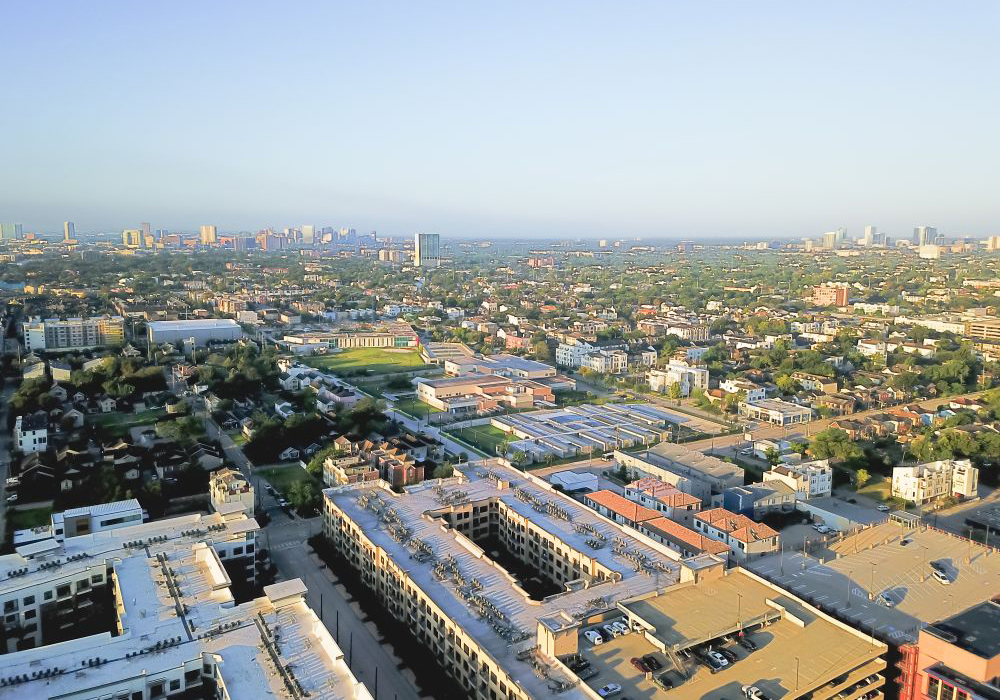
An aerial view of Houston's Fourth Ward, which includes Freedmen's Town. Photo by Trong Nguyen/Getty Images
Preserving Freedmen Town's Legacy
In 2022, Freedmen's Town Conservancy partnered with Contemporary Arts Museum Houston and the city's public works department to launch Rebirth in Action, a three-phase initiative to share the story of Freedmen's Town through the arts and preserve its history and infrastructure.
"We knew we needed to have the city be a part of this program if we wanted to preserve these brick streets, and if we wanted to address aging infrastructure," Fletcher said.
To build trust, Buaku said planners and city officials embraced collaboration and nontraditional forms of outreach, like one-on-one meetings with community leaders. "We had to have hard conversations, the sleepless nights," Buaku said. "My bald spot grew bigger in diameter ... My hair was falling out every day, but that's what we are called as planners to do. We don't do the easy things. We do the hard things."
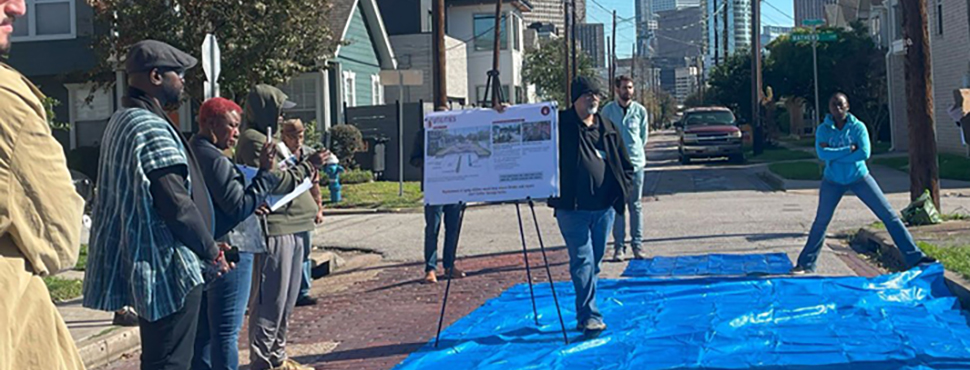
City planners also partnered with Geoff Carleton, AICP, senior principal at TEI Planning + Design, for infrastructure and streetscape design. One of the first orders of business: Documenting how many bricks were currently in the street, the number of patterns they were placed in, and how many in storage were needed for repairs. "That actually became an important part of building trust with the community," Carleton said.
After about six months of community engagement, a design concept report was completed that both community members and the city supported.
"As it gets to the engineering and design phase, we're going to have cultural advisors, including [Fletcher], with us through every step of the process," Buaku said. "We are not disengaging with the community any time soon. We're going all the way to construction."

Watch on Passport
Watch the full presentation to learn more about Rebirth in Action and the next steps of the Houston Freedmen's Town project on Passport.
Top image: Residents weighed the pros and cons of several plans to restore Andrew and Wilson streets in Freedmen's Town. Image courtesy of TEI Planning + Design.
ABOUT THE AUTHOR