


Planning a Better Mindset: Rethinking How We Think

summary
- Science shows that having a gratitude practice can be an effective way to regulate stress.
- A brief, consistent gratitude practice only needs to take two to three minutes a day.
- Gratitude practice can consist of making a list, journaling, or a creative activity.
It is not surprising that the many parts of a planner's job, when thought of cumulatively, can elicit a feeling of overwhelm or an intense focus on things that didn't work as hoped. Combined with an already lengthy to-do list, a gratitude practice can sound less like a support strategy and more like an obligation. Do we really need to add yet another "practice" to our already very full days? The short answer is, in fact, yes.
Not because we need another item on our to-do list, but because science supports the benefits of such a practice. Decades of psychological research suggest that gratitude, when done well, is not an extra task — it is an effective way of regulating stress and restoring perspective under sustained pressure.
Gratitude as a Tool, Not a Chore
Research in positive psychology shows that gratitude supports well-being not by denying the challenges we face, but by reframing our experience. In many ways, this is less about adding a new habit and more about planning a better mindset — intentionally shaping how we process stress, setbacks, and small wins over time. Studies conducted by Dr. Robert Emmons and colleagues have found that engaging in brief, consistent gratitude exercises can lead to lower stress, improved sleep, and greater emotional resilience. Gratitude is especially effective during chronic stress, when challenges are ongoing rather than temporary. It can be instrumental in mitigating burnout, but the key is to embrace it.
Gratitude is effective because of its simplicity. It does not demand long journaling sessions or daily lists; in fact, research suggests that overdoing gratitude significantly limits its impact. Gratitude should be engaged with intentional moderation — it is about moments that mattered in our day, that made us feel seen, supported, and engaged.
How to Start a Gratitude Practice
A gratitude practice can be as straightforward as pausing briefly at the end of the workday or during a familiar transition to reflect on what helped to get us through the day. It does not require carving out time on the calendar. In fact, just two-three minutes a day can have monumental impacts on your well-being.
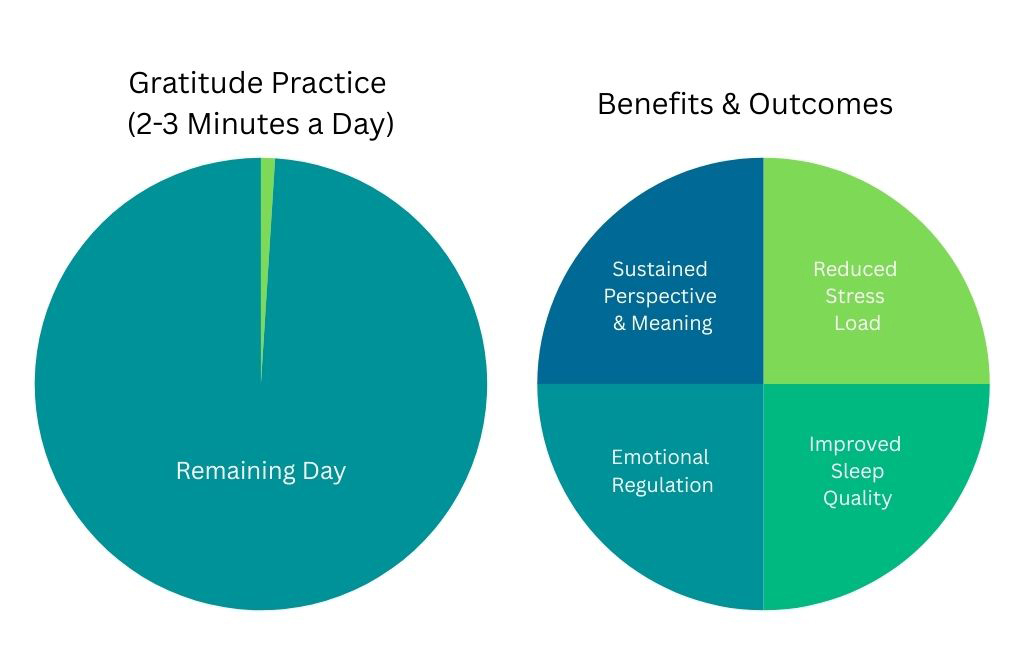
A brief gratitude practice requires less than one quarter of one percent of a 24-hour day, reinforcing research findings that effectiveness comes from consistency and intention rather than time investment (Emmons & McCullough, 2003).
Many approaches can be taken to start a gratitude practice. It can be in the form of a list, journaling, a gratitude jar, or a creative activity that visually represents your gratitude.
Gratitude is Not About Faking It
Most importantly, gratitude should never replace honest acknowledgment of stress or frustration. Those are real feelings that should be acknowledged and validated. Emmons's research shows that gratitude is most beneficial when it coexists with negative emotions, not when it suppresses them. Naming a challenge alongside a stabilizing factor allows us to hold the full reality of our work and life while still recognizing moments of joy or camaraderie.
When gratitude feels like a chore, it is usually because it has been framed as forced positivity. In practicing brief, honest reflection, it becomes something else entirely: a way to notice what sustains us in the demands of everyday life.
Top image: E+ FreshSplash
ABOUT THE AUTHOR