
How to Use the Trend Report for Planners

summary
- The Trend Report is a tool(set) that can help planners prepare for the future.
- The report offers a collection of trends and signals that planners should be aware of and act upon to varying extents.
- In addition, the report outlines different approaches for planners to utilize it in their own work.
The Trend Report for Planners is an annual publication that serves as a tool for planners, developed by the American Planning Association's (APA) foresight team in partnership with the Lincoln Institute of Land Policy. It documents the emerging trends and signals that are shaping the field of planning, or may do so in the future.
How the Trend Report Comes Together
Creating the report is a years-long process of horizon scanning, signals sensing, and trend research that begins with hundreds of inputs that are gradually narrowed down throughout the year.
This process is augmented by APA's Trend Scouting Community, a group of thought leaders from multiple disciplines, industries, backgrounds, career stages, and countries that meet quarterly to provide insights on topics they view as important to be aware of.
To help shape the future, planners must have the ability to imagine it. With the release of the 2026 Trend Report for Planners, let's explore the report features and how to apply them in your work.
Using the Trend Report to Guide Your Work
Not all of the trends collected throughout the year are relevant to planning, nor can all of the ones that are be written about, given the number of pages of the report. To filter out only the most important trends, planners should utilize a prioritization process using two criteria: the impact that the trend will likely have on planning and/or the community, and the certainty that the trend will occur.
This is accomplished by using a two-by-two matrix that plots certainty against impact, both on a high-low binary (i.e., high impact versus low impact). Only those trends that are highly certain to happen and will have a high impact when they do should be prioritized. These will be located in the upper right quadrant of your matrix (Figure 1). This system is designed to be simple and easily replicable for planners to analyze the impact and importance of trends in their communities.
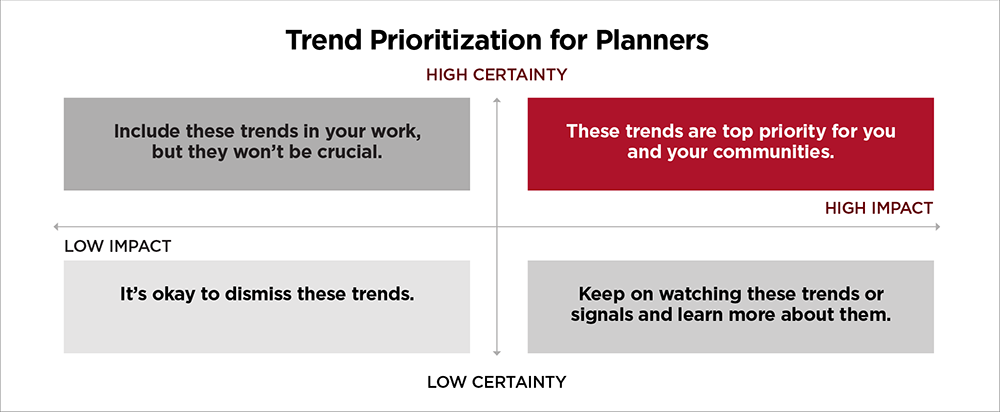
Figure 1. The matrix that you can use to prioritize the trends most relevant to your communities.
action frames: Act Now, Prepare, or Learn and Watch
The Trend Report is divided into three timeframes: Act Now, Prepare, and Learn and Watch. These indicate what actions planners should take about the developments occurring today. These may vary amongst communities and across contexts, but largely hold true regardless of locale.
- Act Now: Trends here have discernible actions that can be taken to address them.
- Prepare: These trends are emerging, and while specific actions to address them may not yet be clear, planners can begin to consider how to incorporate them in plans.
- Learn and Watch: These are signals, which are potential future trends that would be highly disruptive should they eventually become trends, and thus require planners to monitor and learn about them to understand how they develop.
As planners collate and prioritize trends for their own work, they should consider what actions should be taken today to contend with the possible outcomes of each trend in their community.
Scenario planning: Understanding possible futures from uncertainties
Exploratory scenario planning is a process that aims to create multiple possible futures out of uncertainties in a set of trends, which are then used to aid in planning for the most desirable outcomes.
One scenario planning method that can be useful in planning is the Axes of Uncertainty approach using a two-by-two matrix, but this time one that opposes critical uncertainties and the directions that they may take in the future. The extreme uncertainties of the first trend are plotted on one axis, while the extremes of the second trend are plotted on the other. For instance, in the example below (Figure 2), uncertainties around public transit funding and autonomous vehicles are intersected; public transit is fully funded, or public transit is largely defunded, and autonomous vehicles are fully operational, or autonomous vehicles are in limited use in certain cities.
The four quadrants then show what may occur under each set of conditions. A year should also be specified to denote how far into the future to frame these outcomes. The Trend Report includes three scenario matrices from three different timeframes to encourage readers to see the possibilities and creativity that utilizing scenarios can induce. Scenarios can be useful in community engagement when planners are conducting community visioning exercises with constituents, as well as for internal purposes when drafting or updating plans.
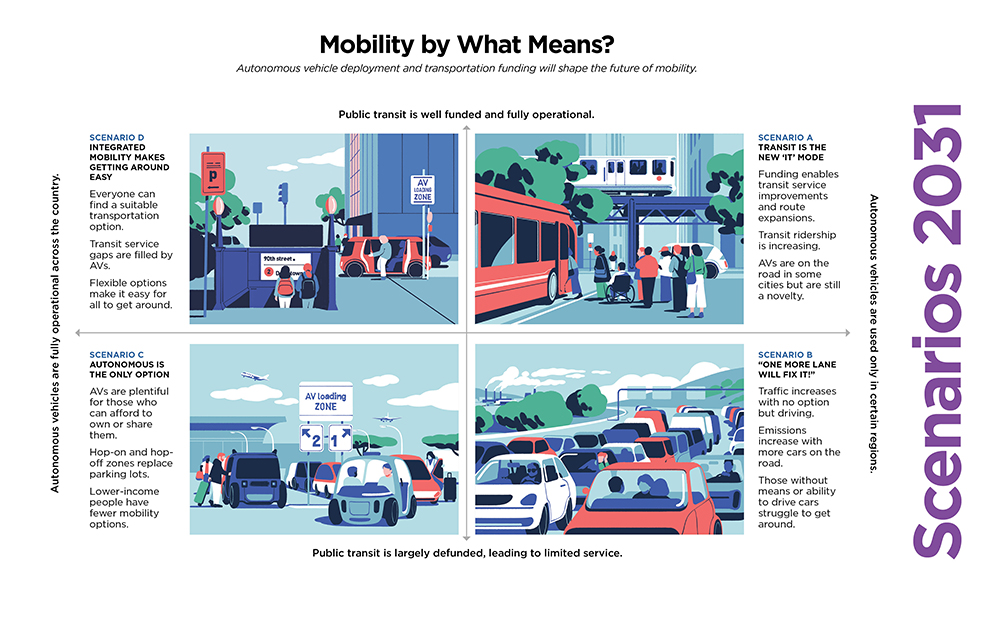
Figure 2. An example of a set of scenarios from the 2026 Trend Report for Planners. Illustrations by Borja Bonaque.
Deep Dives and Trend Talks
There are two additional structural components in the Trend Report beyond scenarios: deep dives and Trend Talks.
Deep dives take a much more focused look at one trend that APA feels is especially important for planners to understand, such as AI governance in this year's report.
Trend talks are interviews with people from a variety of backgrounds, whether it be a student, scientist, or even the APA president. All aim to offer fresh perspectives on planning topics, particularly those that are undergoing some change or development.
You can use these features to learn from professionals and gain a more comprehensive understanding of a set of trends that may stand to make significant impacts in the years to come.
The Trend Universe: Tracking Trend Changes
The 2026 edition is the fifth iteration of the Trend Report. This means there are hundreds of trends that have been documented over the past five years, many of which are still relevant to planners today. These trends are collated online at APA's Trend Universe, a searchable database that describes and tags all of the trends and signals that APA has identified as part of our foresight practice. These are updated biannually, both with new developments to existing trends and the addition of new trends with each report. You can visit the Trend Verse to understand how trends have changed over time and check back regularly to see when new trends emerge.
Engaging with the Trend Report
The Trend Report is not only a document to be read, but it's also a tool to be engaged with. And though the Trend Report is created for planners - who can use it to inform tasks including comprehensive planning, community visioning, and community engagement - it's also utilized by a variety of practitioners to inform the strategic plan of an organization or company, or used as a teaching tool in academia. The world is a constantly evolving place for everyone, and the Trend Report is designed to help make sense of this persistent uncertainty.
Please connect with the APA Foresight team if you wish to integrate futures thinking into your work, want to manage uncertainty in your strategic planning, or simply would like to learn more about what we do. You can contact Zhenia Dulko and visit APA's foresight page to learn about upcoming webinars and trainings.
About the author