


Spotlight on Zoning Practice
How to Avoid Being a (Design) Control Freak

Summary
- Discretionary design review processes can be a major bottleneck for much-needed new development.
- Objective design standards provide planners and local officials with a means to streamline approvals while retaining control over the most important design features.
- These standards work best when rooted in fundamental design principles and paired with a two-tier deviations process.
Minimizing reliance on discretionary reviews has been a consistent theme in zoning reform over the past 25 years. But this is often easier said than done. Local officials may be reluctant to step back from land-use decisions, and the associated public hearings can feel like democracy in action. The problem is that discretionary reviews can be time-consuming, costly, and unpredictable for developers and local jurisdictions alike.
The problem is perhaps most acute in the realm of design review, where subjective design guidelines can slow much-needed development to a halt. According to Valerie Quarles, AICP, and Andrew Faulkner in the March issue of Zoning Practice, "Objective Design Standards for Predictably Better Development," planners and local officials don't need to sacrifice control over site or building design to unstick the development pipeline. The key is to tie design control to fixed criteria known and understood by both applicants and reviewers.
Let Go to Gain Control
Objective design standards are a powerful tool. You can write an objective design standard for any clearly defined, measurable characteristic of the built environment. But, as Quarles and Faulkner note, extensive design standards are perilous at best and counterproductive at worst.
The risk is that, in trying to consider everything, you can make a code too brittle to respond to site-specific conditions and too complicated to be clearly understood. Or you may end up fostering a cookie-cutter built environment that feels more like a movie set or theme park than a community of lasting value. The remedy, according to Quarles and Faulkner, is to focus on the "fundamental, timeless principles of design," such as scale, proportion, and the relationship between a building and its surroundings.
Don't Sweat the Small Stuff
No matter how judicious and careful you are in crafting design standards, you cannot account for every foreseeable development scenario. Furthermore, market conditions change over time. For these reasons, Quarles and Faulkner stress the importance of combining objective design standards with a two-tiered deviation process that distinguishes between minor and significant deviations.
Under this tiered system, staff planners review and make decisions about minor deviation requests. In contrast, significant deviations require a public hearing before a planning, zoning, or design review board. You can tie thresholds for minor deviations to permissible variations in specific building or site design features or to a blanket percentage change in any numerical standard. Developers who can't work within those parameters have the option of going through a more conventional discretionary review and approval process.
Subscribe to Zoning Practice
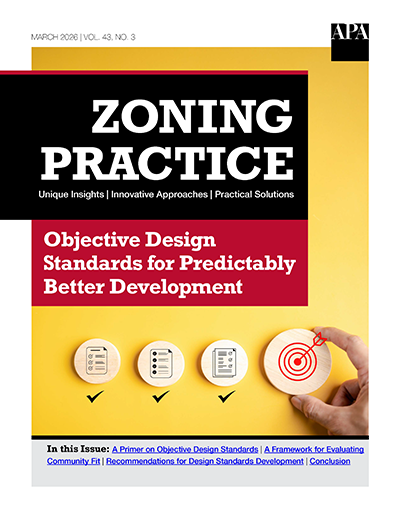
Each issue of Zoning Practice provides practical guidance for planners and land use attorneys engaged in drafting or administering local land use and development regulations. An annual subscription to ZP includes access to the complete archive of previous issues.
Top image: scanrail / iStock / Getty Images Plus