
Thank You AICP and APA!
summary
- Scott D. Turner, FAICP, PE, LEED AP ND, says the American Institute of Certified Planners (AICP) credential "opens doors," helping planners stand out.
- Turner was inducted into the AICP College of Fellows (FAICP) at the American Planning Association's (APA) National Planning Conference (NPC26) in Detroit in April.
- The APA board member also recommends volunteering in the association, as it can build lifelong connections and strengthen professional growth.
After an amazing weekend in Detroit at the American Planning Association's (APA) National Planning Conference (NPC26) in Detroit, I feel compelled to say thank you to the American Institute of Certified Planners (AICP) and APA. I can't imagine where I would be without either of them.
Recently, I was nominated and elected to the AICP College of Fellows, which held its Class of 2026 induction ceremony on April 26. The nomination and application process was a time of significant contemplation and reflection on how my career has evolved over the last 30-plus years. The process makes you think about all the positions you've held, the people you've worked with, the projects you've led, and the impacts you have had on your communities. I've been lucky to work on amazing projects with amazing people.
Like most planners, my planning journey was circuitous. When I was young, I knew I wanted to do something related to the built environment. I initially thought I wanted to be an architect. Eventually, I decided to go to Tufts University for civil engineering. While there, I took a couple of studio architecture courses and cross-registered in the graduate school of Urban and Environmental Policy (UEP), which has since evolved into an accredited planning program. I really enjoyed the UEP courses, which were considerably different than the civil engineering program.
During my junior year at Tufts, I joined APA as a student member. I did graduate with a civil engineering degree, but I knew I wanted something more or bigger than being a civil engineer. I was accepted into and enrolled in the Master's of City Planning program at the Georgia Institute of Technology. My advisor at Tech, who was also a civil engineer, taught infrastructure planning in the planning program. His initial advice to me was to pursue planning but never to drop civil engineering. I was disappointed — I was excited to start my planning career and was reluctant about sticking with civil engineering. However, it was great advice that I took to heart, and so I pursued both.
A Credential That Opens Doors
Professionally, I have worked at four consulting firms over the last 30 years. These firms have allowed me to work on a mix of planning and engineering projects. I received my Professional Engineers (PE) license in 2001 and passed the AICP exam in 2002. Although PE and AICP are completely different, they are equally important to me.
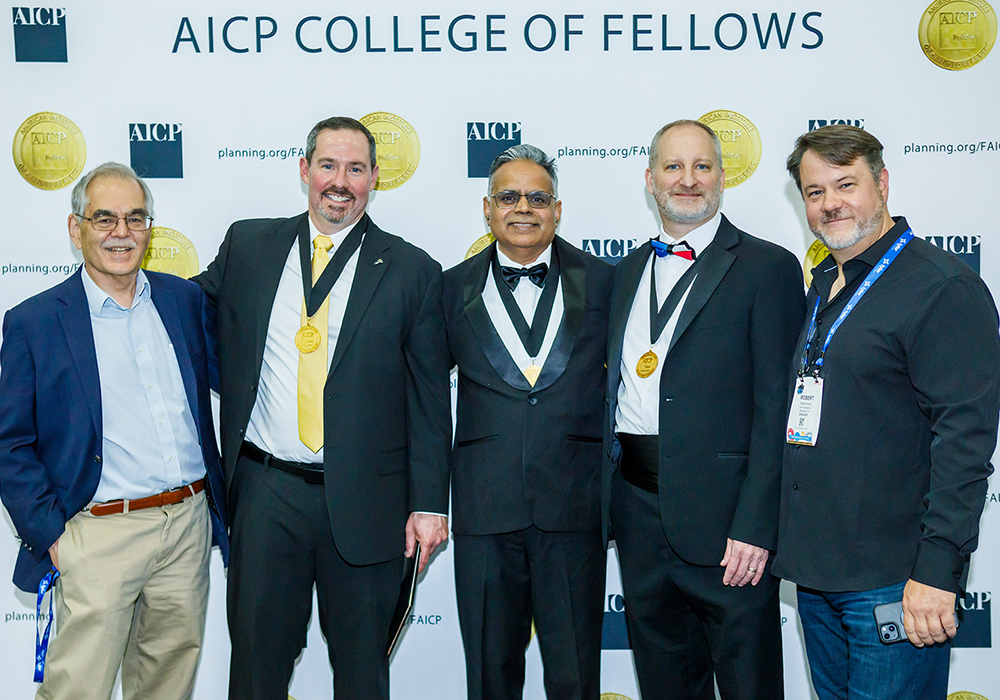
Scott Turner, FAICP (second from left), poses for a photo after being inducted into the Fellows of the American Institute of Certified Planners at NPC26 in Detroit. He is pictured along with (left to right) David Rouse, FAICP, Yogesh Saoji, FAICP, Matthew Bucchin, FAICP, and Robert Kerns, AICP.
Most engineers don't understand why I spend time planning and maintaining AICP. Planners are typically frustrated with engineers. To me, planning and engineering are a natural fit. Engineering design follows the planning process. My engineering background helps me be a better planner. My planning degree helps me be a better engineer. I have had numerous projects where I have performed planning projects that have evolved into design projects. When I am designing projects, I understand how important the planning elements that were identified during the planning phase are, and I make sure they remain part of the project.
Like most planners who work for consulting firms, the companies I have worked for have been primarily engineering firms. It has been my AICP credential that has opened doors for me with these firms and allowed me to hold leadership positions in each. Doing project work requires you to see the big picture that some civil engineers have a hard time seeing. Both my employers and clients have appreciated the big picture thinking that comes with a planning perspective. When I took the position as director of planning at Nitsch Engineering to start their planning department in 2010, the president of the company told me they had plenty of engineers, but no one who was AICP. I was hired to start that department due to the AICP credential. As a consultant responding to requests for proposals, the AICP credential differentiates me from competitors. There have been RFPs that require both a professional engineer and a certified planner, and I fit both.
In other words, the AICP credential has helped me win projects I may not have otherwise won. It was critically important to be hired as the director of planning at Nitsch Engineering.
But the importance of AICP is bigger than simply getting hired by consulting firms or winning projects. When I meet someone who has the AICP credential, I immediately know something about them. They are always good, honest, decent people who are working for the greater good. To me, there is no higher purpose. They are typically incredibly humble. Most planners work in the background, making positive changes in the communities they work in with little fanfare. They are always willing to help. They are my people.
Lifelong Connections Through Membership
I've never been a member of the American Society of Civil Engineers; I have always been a member of APA and AICP. I have spent considerable time volunteering for APA because I believe in the profession, APA, and AICP.
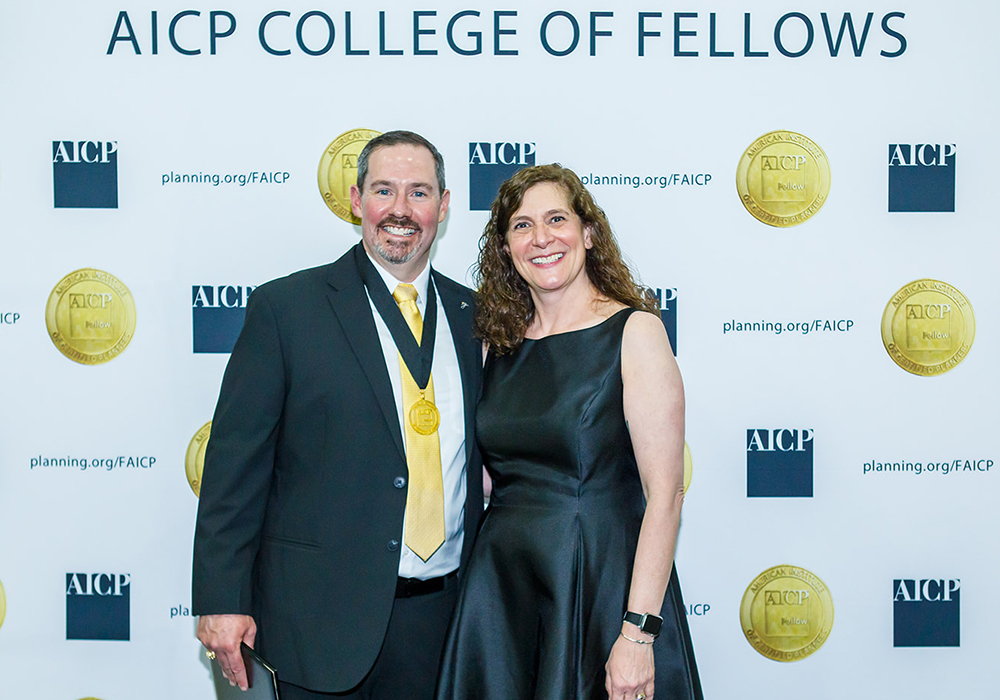
Turner and his wife, Mylissa, moments after the Class of 2026 FAICP induction ceremony.
Volunteering for APA has kept me focused on the mission of making the world a better place. Through all the volunteer work — most of it on the national level — I have met incredible people who have become great friends from all over the country. I only see some of them once a year in person at NPC, but I still consider them some of my best friends. These planners have always been there for me, both professionally and personally. I have partnered with them on projects, presented with them at conferences, and written papers with them. I have learned about different aspects of planning and incorporated what I have learned into my projects, resulting in better projects. They have made me a better planner and a better person.
When I was inducted into FAICP at NPC, they were the ones cheering the loudest. It was unexpected and took me by surprise. That moment confirmed all my choices and decisions about being a planner and volunteering with APA.
Closing Thoughts
If you are considering whether to pursue AICP or volunteer for APA, do both. They will be the best things you can do personally and professionally.
If you've gone to planning school, AICP is the gold standard for our profession. APA is the largest professional organization for planners in the world. Obtaining the AICP credential will open doors for you that you cannot imagine now. Maintaining the credential will ensure you stay current in your field. Volunteering for APA will give back to you in so many ways.
Thanks again to AICP and APA. Although I am happy to be inducted into the College of Fellows, I understand it is an acknowledgement of the impact I have had. But I wouldn't have had that impact without AICP or APA.
It is really the journey I have taken — and continue to take — with APA and AICP that I am most thankful for.
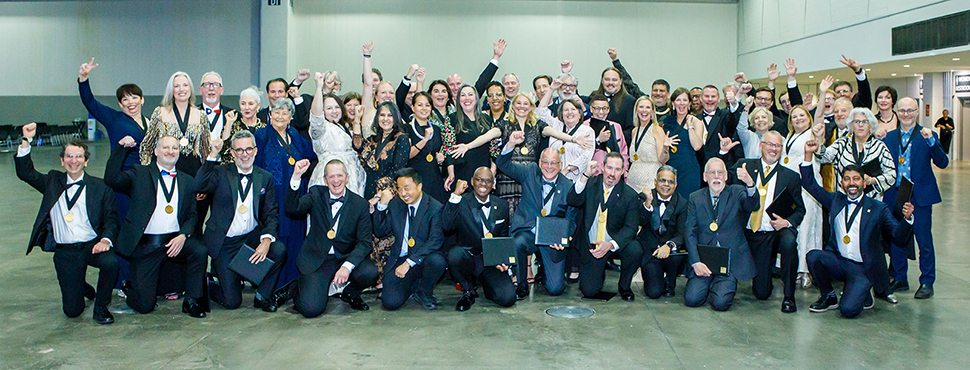
Top image: The 2026 Class of Fellows of the American Institute of Certified Planners celebrate at NPC26. Photo by Hugh Anderson Photography.