
Equity in Practice
Preserving Cultural Identity Along the Green Line: The Little Mekong Story
summary
- Little Mekong in St. Paul, Minnesota, shows how cultural preservation can be built into transit-oriented development.
- Community partnerships helped protect Southeast Asian businesses and identity during Green Line redevelopment.
- The Little Mekong Plaza and Night Market strengthened local commerce, visibility, and community connection.
Beginning in the 1970s, Vietnamese, Lao, Hmong (pronounced "muhng"), and Cambodian refugees began settling along the eastern end of University Avenue in St. Paul, Minnesota. Over time, the corridor evolved into a vibrant community of Southeast Asian commerce and culture in the Twin Cities, with family-owned restaurants, markets, and small businesses. In 2010, however, construction of the Metro Green Line introduced new uncertainty for many of the immigrant-owned businesses that had anchored the neighborhood for decades.
Community Problem
The development of the Metro Green Line brought major infrastructure investment and transit access to University Avenue, but it also caused significant disruption to businesses during construction. Reduced visibility, limited customer access, and long construction timelines placed financial strain on many small businesses, particularly immigrant-owned establishments.
Additionally, the increase in investment and redevelopment in the area raised displacement concerns among community leaders. While expanded public transit access improved mobility and connectivity for residents and businesses along the corridor, stakeholders worried it would gradually erode the area's Southeast Asian identity.
For many residents and business owners, preserving the social and cultural networks tied to the area was essential. Without intentional planning strategies, the corridor risked becoming another example of infrastructure investment reshaping a community without protecting the people and cultural identity already established there.
Planning Solution
In 2012, the Asian Economic Development Association (AEDA) launched an initiative to preserve the area's heritage and economic stability. It also aimed to ease concerns about rising rents and new development pushing out the immigrant-owned businesses and families that had helped define the neighborhood for decades.
The initiative formally branded the neighborhood as "Little Mekong," referencing the river that flows through several Southeast Asian countries and reflecting the cultural backgrounds and heritage of many residents and business owners in the community. Through branding, creative placemaking, business support, and public programming, the initiative formalized and strengthened the cultural fabric of the corridor while increasing visibility and economic support for immigrant-owned businesses.
The City of St. Paul later became an active planning partner in the development of Little Mekong Plaza, a public gathering space designed to support cultural programming and economic activity. The project was developed collaboratively between AEDA, the City of St. Paul, the Saint Paul Riverfront Corporation, Hmong American Partnership, local artists, and community members. Through its "Greening the Green Line" initiative, the city further supported the plaza with technical assistance, planning coordination, and $300,000 in grant funding, helping transform the space into a permanent cultural and economic anchor along the corridor.
Plans for the plaza focused on improving walkability, creating a publicly accessible gathering space, and strengthening support for local businesses. In addition to functioning as cultural infrastructure, the plaza addressed a lack of publicly accessible gathering and green space within the neighborhood.
Because organizations like AEDA already had established relationships within the neighborhood, they were able to facilitate outreach and engagement in ways that traditional planning processes often struggle to achieve. This helped create a planning approach that reflected the priorities of business owners and residents while building trust between the community and public agencies.
Outcome
The Little Mekong initiative helped strengthen the corridor's identity at a time when infrastructure investment could have easily overshadowed and pushed out existing communities. The creation of Little Mekong Plaza established a visible public gathering space rooted in the neighborhood's cultural character, while recurring programming such as the Little Mekong Night Market has increased foot traffic, generated support for local businesses, and attracted visitors to the corridor. The Night Market has evolved into a major regional event that now attracts thousands of visitors each year. The market provides a platform for local businesses, artists, and vendors while introducing new audiences to the neighborhood and its cultural offerings.
AEDA and St. Paul's partnership also demonstrated how cultural preservation can become part of a broader transit-oriented development strategy rather than being treated as separate from redevelopment efforts. By incorporating public space, cultural programming, and community-based economic development into the planning process, St. Paul and AEDA helped stabilize the corridor during a period of transition.
Considerations for Your Community
Little Mekong offers an important example for communities navigating the pressures of redevelopment and infrastructure expansion. While public transit investment can improve mobility, attract new development, and create economic opportunities, it can also place long-standing cultural corridors and small businesses at risk of displacement.
Partnerships between municipal planning departments and trusted community-based organizations can play an important role in redevelopment efforts, particularly within culturally distinct neighborhoods experiencing rapid change.
In Little Mekong, this collaboration helped keep redevelopment efforts focused not only on infrastructure improvements and economic growth, but on the important task of preserving the community.
Equity In Practice
Learn about more ways planners are advancing equity in their communities through the Equity in Practice case studies.
Have an example to share, email publicinfo@planning.org
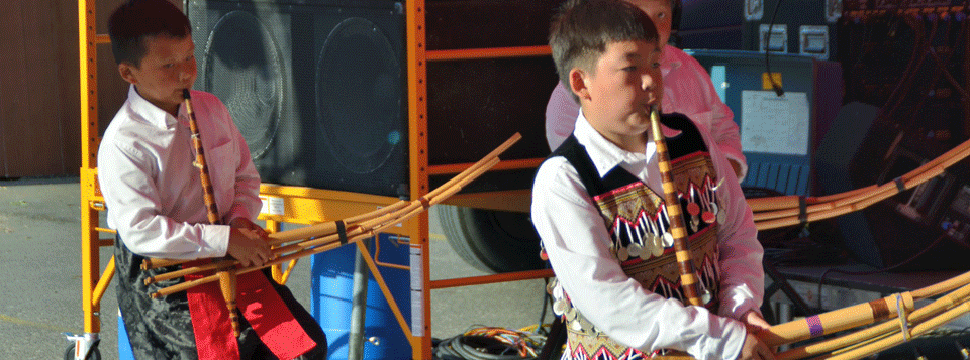
Top image: Traditional Hmong music and dance during the Little Mekong Night Market in St. Paul. Flickr image: jpellgen.
About the author