

What New Zealand Taught Me About Climate Planning
Summary
- Paul Holland, AICP, shares about his fellowship in New Zealand, offering practical lessons on climate planning, land use, and resilience for communities facing growing environmental risks.
- The story explores how New Zealand is using adaptive climate planning and Indigenous knowledge to strengthen infrastructure, policy, and long-term decision-making.
- It also highlights what U.S. planners can learn from New Zealand's approach to climate adaptation and global planning exchange.
There's a saying in New Zealand: "You can’t beat Wellington on a good day." After living and working there last year, I agree. From February to June 2025, I was fortunate to work for the New Zealand Defence Force (NZDF) Climate Change Response Programme (CCRP) as an Ian Axford Fellow in Public Policy.
Established in 1995, the fellowship seeks to increase mutual understanding between the U.S. and New Zealand. NZDF fellows work directly for ministries and departments within New Zealand's government. My experience as a member of the American Institute of Certified Planners (AICP) and my work advising the U.S. government on climate risk, resilience, national security, and land use made me an appealing candidate.
As an Axford Fellow, I was eager to explore the link between security challenges in the Pacific Islands and the climate impacts affecting land use, as well as how New Zealand addresses climate policy challenges.
New Ways to View Climate and Land Use Policies
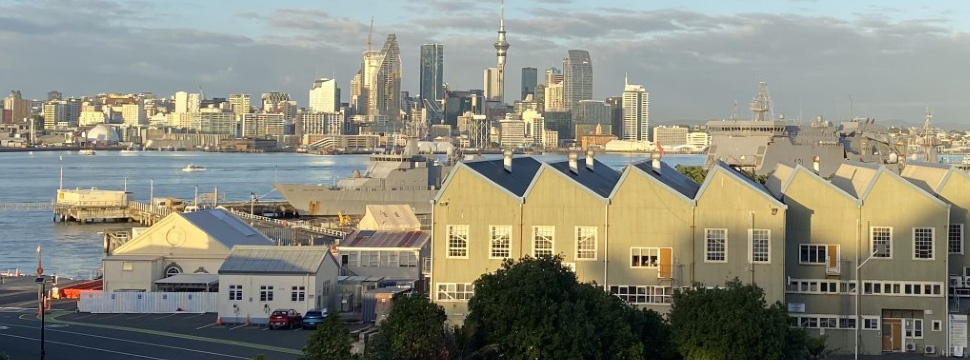
New Zealand is ranked as the second-biggest risk in the world for natural hazards, behind only Bangladesh. The country's infrastructure — including the military bases — is particularly vulnerable to threats from floods, earthquakes, severe weather, and fires exacerbated by climate impacts. In Auckland, for example, the Devonport Naval Base experiences significant flooding during king tide events.
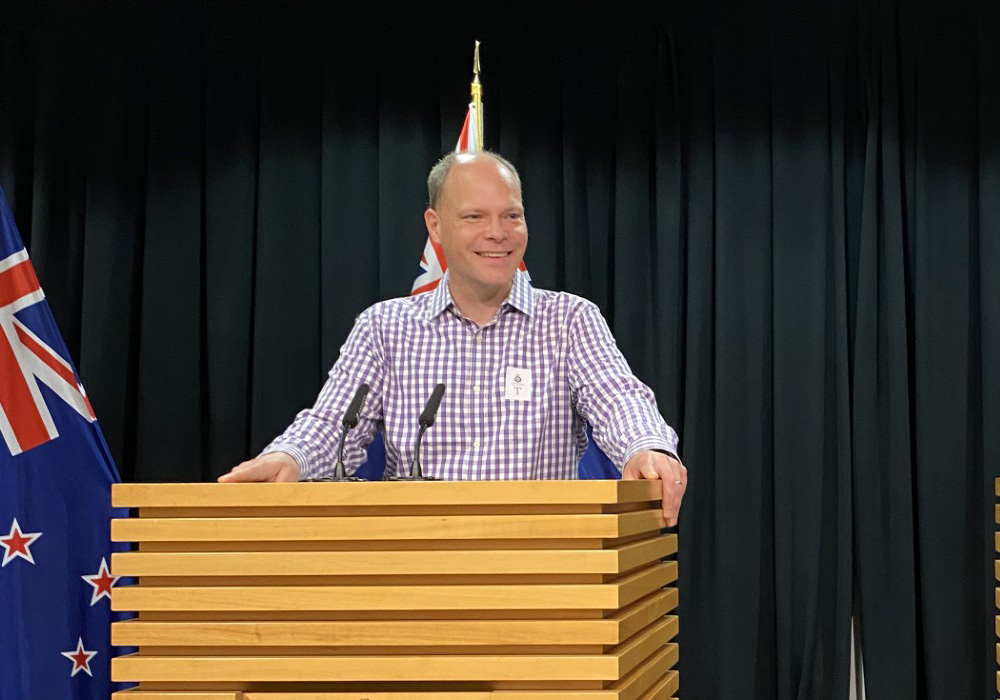
Paul Holland, AICP, holds a mock press conference during a tour of the New Zealand Parliament Building, also known as the Beehive. Photo courtesy of Paul Holland, AICP.
To address these challenges, NZDF is developing Defence Estate Climate Adaptation Plans, site-specific plans prioritizing variable planning, which allow them to adjust their adaptation approaches when climate effects, such as sea-level rise, exceed manageable thresholds. This adaptive approach to planning allows NZDF to assess each climate impact over time and enables NZDF decision-makers to change course when options can no longer meet the stated objectives.
During my time there, I also learned about Te Tiriti o Waitangi (the Treaty of Waitangi), New Zealand's founding document that established the relationship of governance between the Māori chiefs and the British Crown. Māori culture, society, and spiritual domains are centered around land and natural resources. NZDF particularly prioritizes the Māori connection to the land and natural resources, including at Burnham Military Camp, just outside of Christchurch, where I learned how local Māori knowledge systems and centuries of environmental management are informing climate resilience at the base.
Through a reforestation effort, the base is engaged in a long-term project to replace exotic plant species with native varieties. By drawing on traditional Māori knowledge, these collaborative efforts will help strengthen climate resilience at NZDF bases and camps.
It was refreshing to see a society value the indigenous knowledge system. Te Tiriti, and the ongoing interpretations of the document, continues to shape planning and land use in New Zealand for future generations.
Expanding My Planning Network
In addition to my assignment with NZDF, I had the opportunity to meet fellow planners, including at the New Zealand Planning Institute (NZPI) annual conference in March 2025. Held in Invercargill, New Zealand's southernmost city, I met elected officials, fellow planners, and professionals from across the "Ditch," a nickname for the Tasman Sea, which separates New Zealand and Australia.
making global connections
Petra Hurtado, PhD, chief foresight and knowledge officer at the American Planning Association, attended this year's New Zealand Planning Institute's conference. Read her blog post and learn why she came away from the conference believing global exchange matters now more than ever.
The main topic of discussion centered on the future of New Zealand's Resource Management Act (RMA), which provides a comprehensive framework for the sustainable management of natural and physical resources, including air, soil, freshwater, and coastal marine areas. The act also regulates land use and the provision of infrastructure.
Much like the discussion about the future of the National Environmental Policy Act (NEPA) here in the U.S., I found New Zealand's policy reforms both necessary and challenging to implement. But it was refreshing to see the roles that planners were playing in these discussions. The RMA reforms, while still under development, will hopefully result in a new planning system that seeks to unlock infrastructure and housing development, support primary industries, promote economic growth, and conserve natural and environmental resources.
After attending the conference, I met NZPI Chair Andrea Harris for coffee in her hometown of Palmerston North, a dynamic city on the North Island that houses Linton Military Camp — the largest Army base in New Zealand. One of Harris's key initiatives as chair has been connecting with the international planning community.
In her February 2026 "Update from the Chair," she highlighted NZPI's expanded advocacy and engagement and encouraged the NZPI Board to consider how policy changes will affect the broader New Zealand planning community. I was also impressed by her commitment to expanding New Zealand's global planning voice and her engagement with young professional planners. I believe these are also important goals for planners in the U.S.
An Unforgettable Experience
At the end of my Axford Fellowship, I completed my report — "Evaluating Strategic Risks in the Pacific Islands." It analyzed six focus areas: data, investment, infrastructure, engagement, policy and guidance, and education and training. Within each of these areas, I compared the approaches of New Zealand and the U.S. and provided specific policy recommendations for both countries to consider.
My report included a Strengths-Weaknesses-Opportunities-Threats (SWOT) analysis, which outlined a framework for NZDF to implement and prioritize my report’s recommendations. Of particular interest are future opportunities, including improving internal and external relationships to strengthen climate data analysis, establishing stronger community partnerships with the communities that host NZDF camps and bases, and expanding education and training opportunities for climate-related curriculum.
I will always treasure my time working as a citizen diplomat for the NZDF, and the Ian Axford Fellowship opened my world to the amazing history, culture, and people of New Zealand. I encourage planners to apply for the fellowship or to seek out any experience that allows them to learn about planning in another place.
Feel free to contact me with questions at paul.holland@tetratech.com. Based on my time in New Zealand, you won’t regret experiencing Wellington on many good days.
Top image: Devonport Naval Base's South Yard, overlooking Waitematā Harbour and the Auckland Central Business District. Photo courtesy of Paul Holland, AICP.
ABOUT THE AUTHOR