


Spotlight on Zoning Practice
What Can We Do to Minimize the Fallout from Failed Developments?

Summary
- Performance guarantees provide protections for local governments in case a developer cannot follow through with their commitments.
- Successful requirements for financial performance guarantees factor in inflation and the higher costs of public-sector construction.
- If a project does fail, performance guarantees with clear triggers, timeframes, and authorizations can quickly contain the fallout.
Local governments approve development projects with the expectation that they will generate economic benefits for the community and that developers will complete public infrastructure improvements. But what happens when a developer defaults? Los Angeles's Oceanwide Plaza development illustrates the consequences local government may face when a major development fails. This mixed-use development project consisted of three towers and began construction in 2015, but work halted in 2019 after the developer encountered financing problems. The towers sat unfinished for years accumulating graffiti, eventually becoming commonly referred to as the "graffiti towers." The abandoned project ultimately required the city to devote funds to secure the site and address safety concerns.
Oceanwide Plaza's stalled development shows that no project is "too big to fail" and highlights the importance of implementing tools that can anticipate and manage the consequences. October's issue of Zoning Practice, "Optimizing Performance Guarantees," by Wayne Feiden, FAICP, discusses how planners and local governments can use performance guarantees to mitigate risk and improve development outcomes. It examines methods for ensuring guarantees provide adequate protection and can be easily acted on.
Accounting for Development Risk
Financial performance guarantees provide funds to complete improvements when a developer defaults. However, having a guarantee in place does not always mean there will be sufficient funds to complete the guaranteed improvements. Determining an appropriate guarantee amount can be challenging. Conditions may change over the course of a project, and local governments often face higher construction costs than private developers. Feiden explains that because failed developments are not the norm, creating protections that don't overburden the cost of a development project is a difficult process.
Before accepting a financial guarantee, planners and local officials should ensure the funds will cover the potential costs a local government might face. Feiden recommends these costs include inflation rates and reflect costs associated with local procurement policies. Government or third-party inspections can help identify additional issues that the guarantee should account for. These guarantees should also only be accepted from trustworthy grantors, and the local government should have the authority to approve which grantors are accepted. These measures can help ensure that performance guarantees offer strong financial protections for local governments.
Structuring Efficient Guarantees
Creating sufficient protections is only part of structuring an effective performance guarantee. Local governments also need to ensure they can access the funds and address unfinished work when a project fails. When a performance guarantee does not clearly outline conditions for drawing on the guarantee, or if the guarantee expires before the work is completed, those funds can become unavailable. Even when funds are available, a guarantee may limit protections if the local government lacks the authority to enter the site to complete unfinished work.
To ensure the funds remain available, local development regulations should require applicants to provide guarantees that stay in effect until the project is completed or automatically renew. Regulations should also establish clear conditions for drawing on a guarantee, which should include a developer defaulting or a guarantee expiring. Feiden also recommends securing an irrevocable right of entry and ensuring private restrictions do not prohibit local government from entering the property to complete public work. Local governments can better address the consequences of a developer defaulting when a performance guarantee thoroughly assesses risk and allows governments to respond.
Subscribe to Zoning Practice
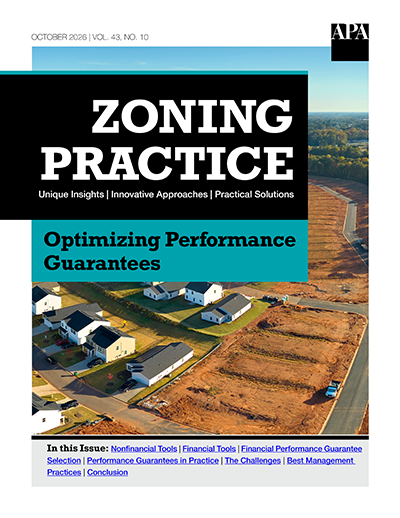
Each issue of Zoning Practice provides practical guidance for planners and land use attorneys engaged in drafting or administering local land use and development regulations. An annual subscription to ZP includes access to the complete archive of previous issues.
Top image: Dutcher Aerials / iStock Unreleased