

March 19, 2026
Eric Corey Freed, AIA, LEED Fellow, has spent decades working to make the built environment — and therefore our world — more sustainable. Recently, the architect and sustainability director for CannonDesign uncovered a new tool that not only helps him do that but also enables his clients to understand how urban design elements come together.
Freed uses the steps and concepts laid out in the book The Sustainable Urban Design Handbook to better understand sustainability at a neighborhood level, rather than building by building, and to show clients options that are appropriate to the site, climate, and other factors.
One project is the Alice L. Walton Foundation's Bentonville Health Care Campus in Arkansas, which takes a comprehensive approach to health. "Rather than a series of clinical buildings connected with parking lots, the campus is a fully integrated environment focused on enhancing whole-person health — physical, mental, social, and emotional well-being," declares the project website. Freed says the book and its framework have meant he and his colleagues could answer client questions in real time and "model at the speed of design."
The Sustainable Urban Design Handbook, published by Routledge in 2024, was co-authored by Nico Larco, AIA, professor of architecture and urban design at the University of Oregon and principal of the consulting firm ELEMENT Urban Design, and Kaarin Knudson, AIA, a licensed architect, urban designer, and the mayor of Eugene, Oregon. Larco and Knudson were guests on People Behind the Plans, a podcast from the American Planning Association (APA) hosted by APA Editor in Chief Meghan Stromberg. (APA members receive a 30 percent discount on all books published by Routledge.)
The handbook uses the sustainable urban design framework, a concept Larco developed 15 years ago when he was searching for a holistic way to consider sustainability — particularly the interplay, impact, and tradeoffs of various elements and approaches.
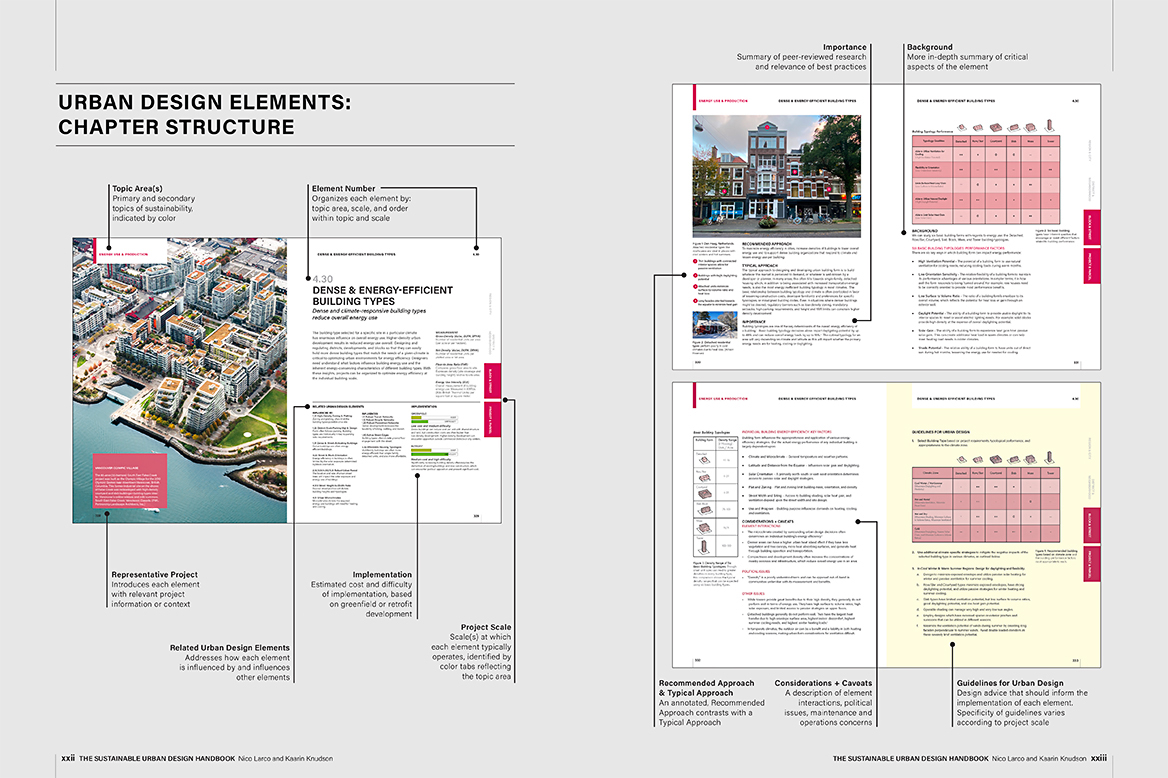
The handbook organizes 50-plus elements into five core sustainability topics and four project scales. It defines each element, such as multimodal street design, and gives context and recommended approaches. View the handbook structure and chapter page at full size in a new tab. Source: The Sustainable Urban Design Handbook by Nico Larco and Kaarin Knudson, Routledge (2024).
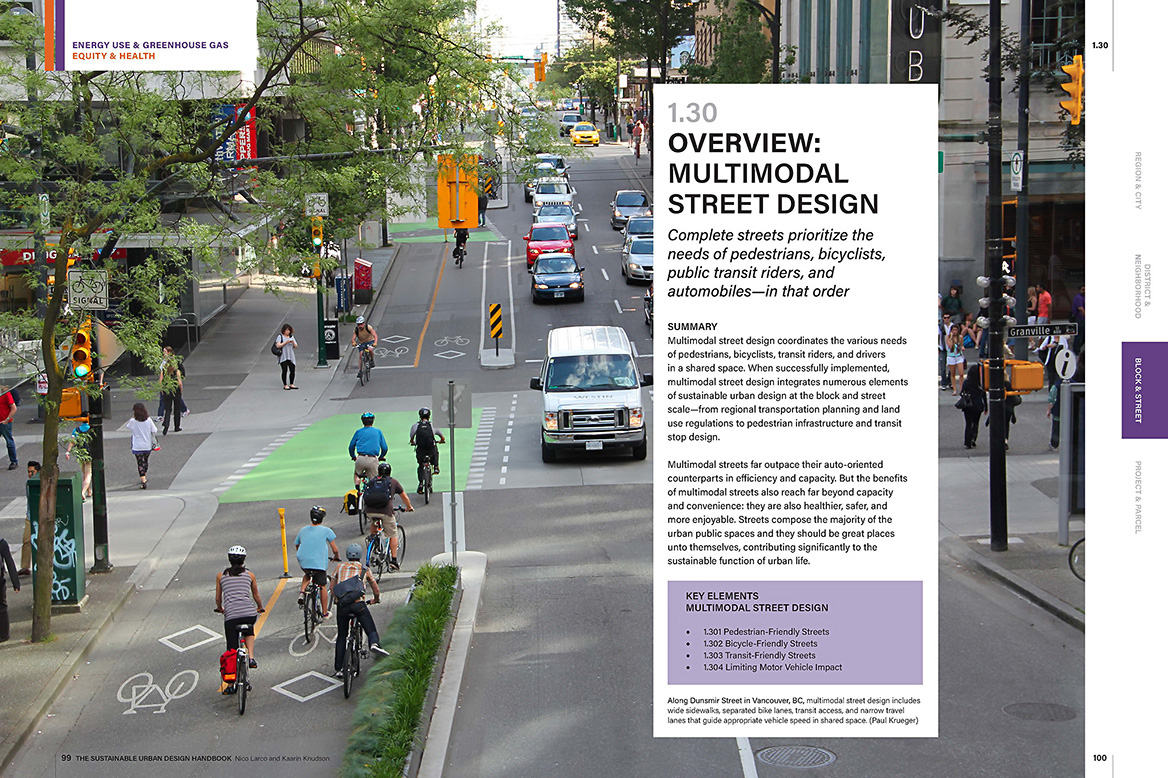
"Mostly siloed and pretty complicated." That was Larco's assessment of existing information about the many aspects of sustainable design, so he created a framework — and later a book with co-author Knudson — that describes each element and shows how all the puzzle pieces fit together. Entries also include recommended approaches and implementation difficulty by site type.
More than 50 elements are included in the 438-page handbook, which has color-coded sections based on five main sustainability outcomes. Individual elements are identified within those topic areas, and they also are grouped by scale, from the parcel level to a whole region.
Each element, such as "compact development" or "robust urban forest," includes a description, recommended approaches, level of implementation difficulty in various site types, and importance in the grand scheme of sustainability. The framework, Larco has been told, helps users manage their projects' "laundry lists" of design approaches.
For planners, sorting that out to support wise decision-making is key. "So often, planners are in the role of explaining not just how we could do something, but also all of the 'whens' and a whole bunch of the 'whys,'" says Knudson. "When you know enough about the ways in which your decision might impact someone else, you can have a more specific conversation about managing the consequences and navigating the tradeoffs to get the most sustainable and best possible outcomes."
She gives an example of green roofs as a sustainability solution. While green roofs are a great solution in certain circumstances, she says, they aren't often feasible for communities with decades-old buildings that might not structurally support that type of retrofit. In that case, what do you do to achieve a similar or even better outcome?
Ultimately, Larco says, the handbook can be used as "a guide to figure out what kinds of things we should be measuring, what kinds of things really impact these outcome goals, and whether we're considering the right outcome goals."
RECOMMENDED ARTICLES