

March 12, 2026
If you can handle the fast-paced frenzy, Disney's new Zootopia 2 offers lessons rooted in societal issues all too familiar for urban planners.
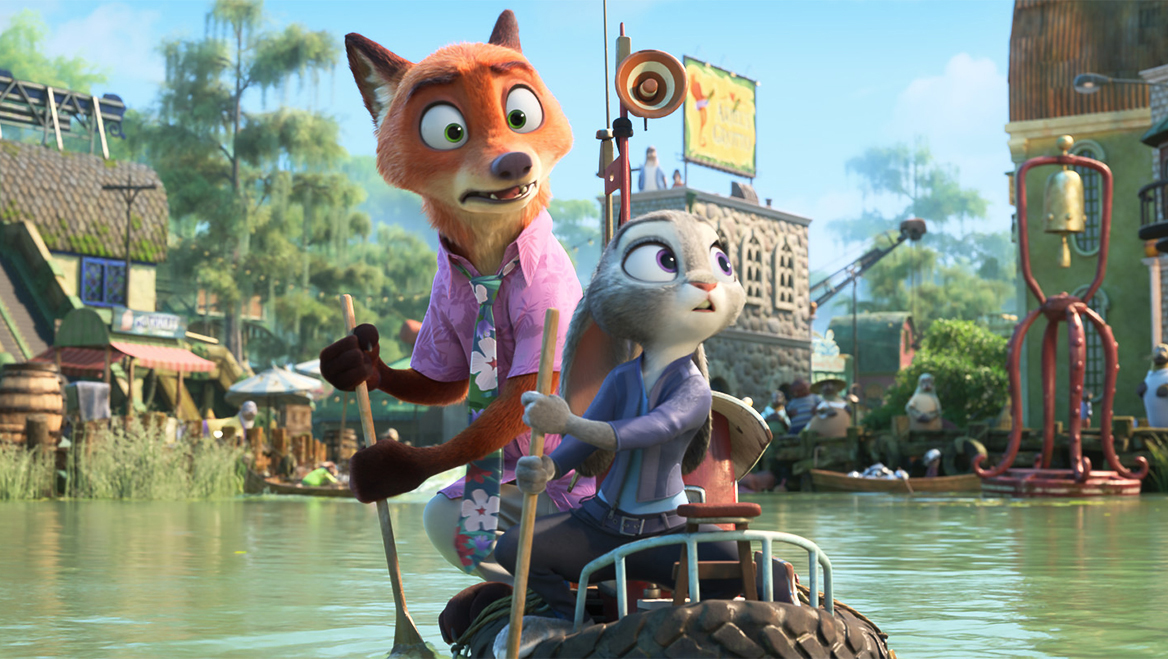
The long-awaited sequel released this past fall takes viewers on a two-hour thrill ride of crime, comedy, and high-speed chaos. It follows the ongoing exploits of lovable Zootopia Police Department rookies Judy Hopps (a plucky and upbeat rabbit voiced by Ginnifer Goodwin) and Nick Wilde (a wily fox with a rap sheet, voiced by Jason Bateman) as the unlikely duo attempts to prove they are, in fact, good cops. In between its twists, turns, and jokes, the movie also explores mainstream representations of cities and planning.
The first Zootopia came out a decade ago, which feels like eons in kid-years. The original fan base is now in high school or beyond, and a lot has changed since then. As a result, the sequel is understandably pitched to a more skeptical audience of young viewers, who (like the adults around them) may be less willing to blithely accept the futuristic techno-utopian optimism of the original film.
Zootopia is a bustling, diverse city, home to animals from every climate and ecozone on Earth, all living in relative harmony. The secret to keeping everyone happy is the ingenious technology behind the city's "weather walls" that allow for the creation of different neighborhoods and districts with suitable environments for each species: polar bears and reindeer in "Tundratown," beavers and walruses in the swampy "Marsh Market," lions and gazelles in the "Savannah Central" downtown, and so on.
Planners who know the history of zoning and segregation may immediately suspect a problematic parallel. Is it really a good idea to structure your city along such rigid lines? Is it fair? Will it lead to division and inequality, lawsuits, or violence? Early on, these concerns are mostly downplayed. The premise emphasizes how different districts allow for all the animals to coexist in relative harmony, reminiscent of the "Peaceable Kingdom" ideals of previous generations.
Likewise, those familiar with the planning profession's early and often unreflective attempts to control the environment through technology and engineering may cry foul. Is it really a good idea to manipulate the weather so cavalierly, rather than learning to adapt our own behavior and live in balance with nature? The film largely skips over this potential concern, although I can imagine it leading to a great potential plot for a third installment exploring the breakdown of the weather walls and the return of nature — with a vengeance.
One suspects that a true utopian city might be trickier to keep in balance, even if you can get the temperature right for everyone. Instead of viewing these unexplored themes with an overly critical eye (it is a Disney movie, after all), the film might be used to start conversations and encourage younger viewers to use the animal city to think about how we all can live together.
These shortcomings and omissions aside, the film finds its courage in the third act. As Judy and Nick unravel the mystery at the heart of the plot, we learn that the weather wall technology was originally used not for good, but rather to displace and disenfranchise entire animal communities, destroying their habitats and clearing their valuable land for new development benefiting others. As with projects from the urban renewal and highway construction eras (and even more recent ones), land use planning and infrastructure development are not necessarily neutral acts — and an "improvement" to one group may be a threat to another.
The message hits hard, but it is fair criticism and the film does a great job revealing Zootopia's ugly past without dashing all hope. Past injustices can be acknowledged, and, with honesty, we can continue to work together to build a truer utopia.
Zootopia 2 is available for streaming through Amazon, Apple, Google, YouTube, and other major streaming platforms.
If you liked Zootopia 2, you may also enjoy ...
WHO FRAMED ROGER RABBIT? (1988)
This retro film-noir comedy popularized an important chapter in the history of urban planning. With a tongue-in-cheek nod to Chinatown (another great Los Angeles urban planning movie), hard-boiled detective Eddie Valiant (Bob Hoskins) uncovers a secret plot to consolidate and undermine the city's once-great electric trolley network. Early in the film, Eddie quips, "Who needs a car in LA? We've got the best public transportation in the world!"
Who Framed Roger Rabbit? is available to stream on Disney+.
WALL-E (2008)
With a stunning, wordless introductory sequence lasting nearly 30 minutes, this film opens on a barren Earth, littered with trash and abandoned by the billions it once nourished. Following a quirky trash-recycling robot (Wall-E) who falls for a cute and coy life-seeking probe unit (Eve), the story eventually catches up with the humans who must learn to return to their home and relearn how to live with nature and each other. It's a good reminder that as long as we have people and communities, we will always need planners.
WALL-E is available to stream on Disney+.
PRINCESS MONONOKE (1997)
Through more than a dozen animated classics, Hayao Miyazaki has consistently explored questions of development, industrialization, spatial conflict, displacement, climate change, and environmental destruction. Princess Mononoke is one of his best, providing a passionate plea for more empathic and mindful approaches to the ways we value our planet; its resources; and the people, communities, animals, and ecosystems we share.
Princess Mononoke is available to stream on Disney+ and HBO Max.
RECOMMENDED ARTICLES