



Oct. 13, 2026
Cities are complicated systems, but for Shruti Shankar, AICP, that complexity can be a strength. The urban design director and associate principal at Studio One Eleven in Long Beach, California, has a layered approach to city-making that merges her training as an architect, work in urban design, and certification in planning.
Shankar recently spoke on an episode of the American Planning Association (APA) podcast, People Behind the Plans, about planning for mobility hubs and major events, the differences between cities in the U.S. and India, and the importance of mentorship. This interview has been edited for length and clarity. Listen to the whole conversation at planning.org/podcast.
MEGHAN STROMBERG: Tell me about creating mobility hubs for people.
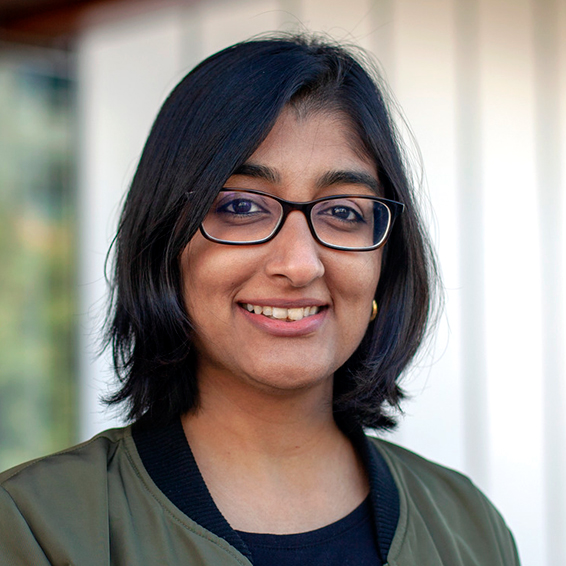
Shruti Shankar, AICP, is the urban design director and associate principal at Studio One Eleven in Long Beach, California. Photo courtesy of Studio One Eleven.
SHRUTI SHANKAR: Conceptually, it’s a place where you go to switch modes of travel, but a mobility hub can be so much more. Oftentimes, train stations and bus stops go in the leftover places after freeways, parking, and other high-priority uses are sited, and there are all these competing interests, management entities, and stakeholders — how do you navigate all that to create the best experience for a person waiting for a bus on a sidewalk where there’s no shade? We started experimenting — almost a decade ago — by piloting bike lanes along the curb, adding rideshare pickup and drop-off zones, creating parklets. It kicked off this work around mobility hubs very intentionally.
STROMBERG: That seems important with the FIFA World Cup, Olympic Games, and Paralympic Games all happening in Los Angeles. What’s the mood there?
SHANKAR: It’s pretty messy, but in good ways sometimes. I feel like there is a lot of energy; there’s a lot of enthusiasm to try to tackle these big questions about what we’re going to put forward when we’re on the world stage, and a lot of effort is going into planning at a variety of levels.
For those who are not familiar, LA County has 88 jurisdictions, and the Games will take place across the county. The Los Angeles County Metropolitan Transportation Authority has a big charge to get people to the Games safely and conveniently, and it’s expected to be a no-car Games. That’s a lot of pressure to find other ways of getting people around. In addition, there’s a lot of hope and excitement around being able to showcase the different communities and cultures in LA and the broader area.
STROMBERG: I love that you admitted that it’s “kind of messy.” I saw a phrase on your firm’s website that says, “Cities are messy. We love the mess.”
SHANKAR: It’s a funny thing to admit, especially as planners and designers. But when you think about city-making, you have to admit that it’s a very complex system, and everything you do has very compounded unintended consequences. But “we love the mess” also acknowledges that it is what makes cities great. Sometimes, relaxing a little bit of control and just letting people take ownership of cities in a way that’s meaningful can lead to a lot of great outcomes.
Sometimes, relaxing a little bit of control and just letting people take ownership of cities in a way that’s meaningful can lead to a lot of great outcomes.
STROMBERG: You started your career as an architect in India. How do those experiences compare to urban design in the U.S.?
SHANKAR: I think Indian cities, like cities in other parts of Asia, have that messy vibrancy that comes from population density and a bit of open-endedness with city planning. What’s really lacking is the infrastructure and systems that provide broader safety and improvements that can benefit everyone. A lot of my work there focused on how we redo our streetscapes and provide comfortable sidewalks for pedestrians without destroying the life of the street that already exists. That’s a very different frame of mind from what we’ve done here, which is bringing life back into those streets that have already been designed and engineered for everything but people.
STROMBERG: Thinking over your career, what role has mentoring played?
SHANKAR: I’ve had some great mentors in my past life as an architect in India and in my time here working at Studio One Eleven. The partners of the firm — Alan Pullman and Michael Bohn — have certainly played a big role in that. I also had a wonderful supervisor, Shannon Heffernan, AICP, who really encouraged me to work toward my AICP and think about the planning profession as a place where we could have an impact.
I’ve always found it to be very enriching to work with students and people starting out in their careers and really help guide them. As I’ve also grown in my professional capacity, it’s also been wonderful to have peer mentor relationships, especially with women. It’s so beneficial to have someone there to brainstorm with, challenge assumptions, and think through problems without feeling like you need to be right all the time. That’s what mentors often have done for me.
RECOMMENDED ARTICLES