


Oct. 29, 2026
Many U.S. downtowns have good bones — a connected small-block street network, mixed uses in proximity to each other, and rich historic architecture. Yet, they often struggle to nurture vibrant street life and business vitality because their streets are engineered for speed rather than safety.
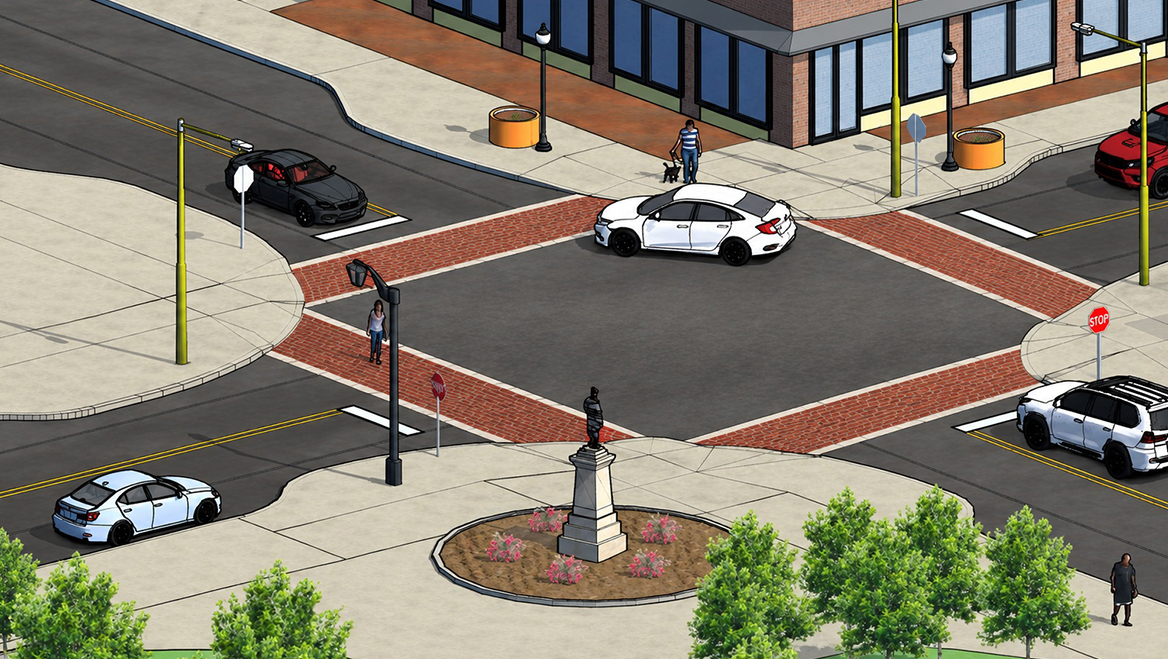
Cities from Fort Lauderdale to Boise have leveraged traffic-calming strategies to spur downtown revitalization, including restoring two-way travel from one-ways, converting traffic signals to all-way stop signs, and repurposing excess lanes — all tactics that compel motorists to drive at the speed limit.
Scranton, Pennsylvania, is one of the latest cities to follow suit. Mayor Paige G. Cognetti commissioned a Downtown Connectivity Plan to identify the factors that would most affect the number of people walking, biking, and taking transit downtown, as well as improve safety, health, livability, and sustainability.
“Our residents, small business owners, and our visitors deserve to be safe when traveling,” Cognetti says. “That’s the primary goal of the multiple projects we’re pursuing. We want to strategically slow down traffic for drivers and make downtown more inviting for pedestrians. Along the way, we’re also building a more inviting and vibrant city center that’s full of unique businesses and living opportunities.”
The resulting plan, submitted by Speck Dempsey (formerly Speck & Associates) and Nelson\Nygaard Consulting Associates in June 2023 and approved in 2025, built on lessons learned from dozens of other walkability studies that planner and Speck Dempsey partner Jeff Speck has worked on. The plan focuses on street-by-street reconfigurations, including adding bike facilities, on-street parking, and street trees.
Today, implementation is in full swing. The plan was the single largest ever submitted in the Pennsylvania Department of Transportation (PennDOT) district where the city’s downtown is located, and support has been swift. Many key proposals are slated for construction or already underway, with $21.9 million in dedicated funding. Four major one-way streets around the historic Courthouse Square are estimated to become two-way by summer 2027, after six decades during which circling the square in a car was a physical impossibility. Nine traffic signals will be replaced with all-way stop signs, and nearly 70 new on-street parking spaces will replace excess lanes.
Dozens of traffic-calming tactics will also be implemented, including curb bump-outs, leading pedestrian intervals, and re-striped crosswalks. Lackawanna Avenue, a major street, will see new sidewalks, lighting, and a relocated bus shelter. These changes are poised to produce substantial safety and aesthetic gains for Scranton’s residents, workers, and visitors.
The benefits of two-way street reversions
Two-way reversions reduce speeds and save lives. In Louisville, Kentucky, researchers studied four adjacent one-way streets, two of which were restored to two-way traffic in 2011. After the change, the two-way streets handled more traffic but experienced a 49 percent drop in total collisions. The same study also revealed that one-way streets beget crime, most likely a result of higher speeds and lower sidewalk activity. On the reverted streets, reported crimes fell approximately 23 percent.
Beyond safety, the reintroduction of two-way travel boosts local business revenues, documented in communities including Chattanooga, Tennessee; Lynchburg, Virginia; and Vancouver, Washington.
Safety over Speed
The traffic-calming measures Scranton, Pennsylvania, is using to revitalize its downtown.

in dedicated project funding.

streets converted from one-way.

become all-way stop signs.

for on-street parking.
Another advantage of two-way restorations is that costly traffic signals can often be replaced with inexpensive all-way stop signs. These provide their own dramatic safety benefits: In a large-scale Philadelphia study, converting signals to all-way stops was found to curb severe injury crashes by 62.5 percent.
Speck has consistently recommended these strategies in his walkability studies. In Mobile, Alabama, implementation of a Speck and Nelson\Nygaard “Street Optimization Plan” reverted eight streets to two-way and nearly half of its 56 downtown traffic signals to all-way stops in 2025 and 2026.
Admittedly, no planner wants to be accused of being unduly formulaic, but “the two-way to one-way conversion was a destructive rubber stamp that planners and engineers ruthlessly inflicted upon downtowns in the mid-20th century,” Speck contends. “Reversing a mistake perpetrated nationwide is a rubber stamp I can get behind.”
Making it happen in Scranton
Downtown plans are typically hard to pull off in the Keystone State because PennDOT oversees state-controlled streets, holds veto authority over signalization changes, and governs city-controlled streets that intersect with state-controlled ones.
In Scranton’s case, though, city staff and consultants worked with PennDOT for more than a year — including meeting biweekly — to iteratively assess, modify, and endorse the proposed changes. Scranton City Engineer Tom Reilly, Jr., notes that an “extra level of coordination helped everyone remain focused” and was critical to the project’s approval.
“Big plans like this require vision and grace in equal measure,” adds Nelson\Nygaard Principal Alyson Fletcher.
Scranton officials expect to complete all the plan’s improvements by summer 2027. While Scranton’s constituents still hold a range of opinions about the proposed restriping, resignalization, and construction, the Lackawanna Blind Association (LBA) in October 2025 filed a letter of support. A deep engagement with the blind community led to accessibility enhancements, including stop signs equipped with pedestrian-activated audible and flashing indicators.
“The City’s current leaders, perhaps especially Mayor Cognetti, deserve recognition for the foresight to collaborate with residents, businesses, advocacy groups, and private developers to build a downtown that is altogether safer for pedestrians, cyclists, and drivers,” Speck says.
Continued momentum and public education about the project’s benefits will be necessary to assuage other community concerns. Regardless, the process that enabled such transformative changes to take root is an impressive example of a community engaging in sustained, intentional partnership to deliver real progress in Jane Jacobs’s hometown.
RECOMMENDED ARTICLES