
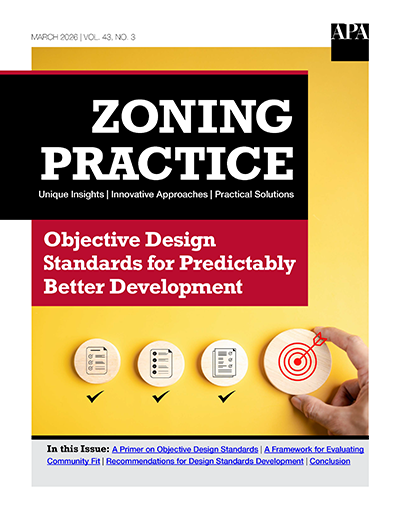
Objective Design Standards for Predictably Better Development
Zoning Practice — March 2026
By Valerie Quarles, AICP, Andrew Faulkner
Zoning is the primary tool cities, towns, and counties across the United States use to organize and control growth and investment in the built environment. Since Euclid v. Ambler in 1926, zoning has evolved from regulating property uses to an all-purpose tool. However, zoning is frequently inadequate at addressing qualitative issues of building design.
For the past 50 years, many communities have used subjective design guidelines to augment zoning. Ideally, such guidelines mesh with zoning rules to control building and site appearance by focusing on materials, massing, roof forms, color, and landscaping. In practice, these guidelines can be vague, contradictory, and legally perilous. Consequently, in recent decades, a growing number of local jurisdictions have replaced discretionary guidelines with objective design standards.
This issue of Zoning Practice explores key considerations for communities contemplating new design standards. It begins with a brief summary of the core features of zoning-related design controls before evaluating the pros and cons of objective design standards and presenting recommendations to guide planners and local officials through the process of developing appropriate standards.
Details
About the Authors
Valerie Quarles, AICP
<p>Valerie (Val) Quarles, AICP, is a Senior Planner at the City of Saint Paul. She holds a B.S. in Urban Studies from the University of Minnesota and serves as the Co-Chair for the ULI MN UrbanPlan program. She has previously served as a Planning Commissioner for the City of Little Canada, along with working at the Metropolitan Council, Musicant Group, City of Golden Valley, and City of Wayzata. In her free time, she enjoys running, biking, and swimming all over the Twin Cities.</p>
Andrew Faulkner
Andrew J. Faulkner is a Senor Urban Design Associate and registered architect (CA, MN) for the Minneapolis office of Van Meter Williams Pollack. Andrew has written Objective Design Standards for the cities of Wayzata, Minnesota and Pleasanton, California and has contributed subject matter expertise on design standards to Foster City, California and the Balboa Reservoir Special Use District in San Francisco.
Andrew has also served as City Architect for the Wayzata Boulevard Corridor Plan. Andrew has served as project architect for almost 300 units of LIHTC new multifamily construction and reahbilitation projects.
Andrew believes that the potential of design is realized through the creation of sustainable, inclusive, and resilient places to live and work, and successful design works across scales from the home to the city beyond. In addition to Andrew’s experience in community design and multifamily housing, he
was an adjunct professor in architecture and urban design (2010-2012) at Washington University in St. Louis. Andrew has advocated rethinking the impact of highways on urban communities as a founding member of the ConnectOakland organization (2015-2020) and as an assistant director of City To River in Saint Louis (2007-2012).