
Modernizing Adequate Public Facilities Practices
Zoning Practice — April 2026
By Courtney Powell, AICP
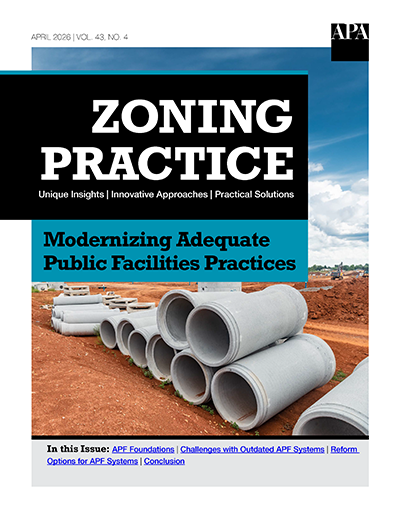
The concept of adequate public facilities (APF) or concurrency is relatively straightforward in principle: Approve growth only when public facilities, such as transportation, water and sewer systems, schools, parks, and emergency services, can accommodate the increased demand while maintaining an acceptable level of service (LOS). Designed to ensure that development proceeds only when the necessary infrastructure is available or is being planned, APF serve as both a safeguard and an occasional constraint.
Although APF is not a new concept, APF systems have, historically, relied on single-mode metrics, such as intersection delay or seat counts, and use binary pass-fail tests to gauge success. When based on outdated, incomplete, or inflexible data, APF can be a significant barrier to needed housing, particularly in regions already experiencing affordability challenges. As communities expand their goals to include complete streets, Vision Zero, increased transit ridership, attainable housing, climate resilience, and environmental justice, these older frameworks frequently conflict with modern ambitions.
This issue of Zoning Practice explores how planners can reframe APF as an adaptable, outcome-oriented tool that effectively aligns growth approvals with future-oriented priorities. It begins with a summary of challenges associated with outdated APF systems before highlighting a range of considerations for APF reforms.
Details
About the Author
Courtney Powell, AICP
Courtney is a department manager at WGI as the Urban and Community Planning Manager, leading a talented team specializing in urban and community planning. With a strong understanding of local government operations, she specializes in comprehensive and policy planning, small area plans, land management ordinance administration, report and text amendment writing, public engagement, public presentation, municipal processes, customer service, and project management. As an AICP-certified planner, she leverages her acquired academic knowledge and work experience from the private and public sectors to deliver a high standard of practice, ethics, and professional conduct to improve the quality of life for community stakeholders. With her extensive public planning and project management experience, she has facilitated several successful planning processes, open houses, and stakeholder groups in a collaborative and welcoming environment. Courtney has shared her strategies as a speaker for the IAP2 Digital Discovery Workshop: The Virtual Presentation. Her passion for creating tailored processes and a sense of place drive her to find creative and implementable solutions. Courtney is active in professional associations as the APA Virginia VP of Legislative and Policy Affairs and is engaged in leadership learning for continued professional growth. Courtney has a dual bachelor’s degree from Furman University in the Arts and Urban Studies, and a Master of City and Regional Planning degree from Clemson University.