
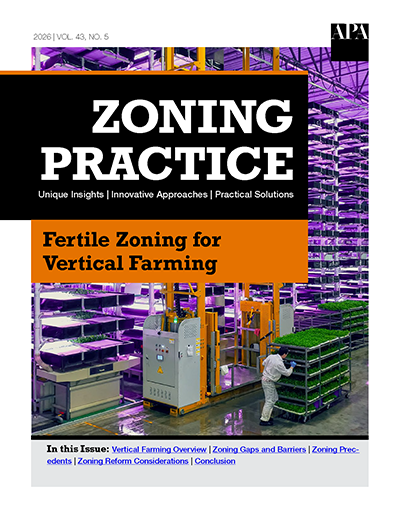
Fertile Zoning for Vertical Farming
Zoning Practice — May 2026
By Derrick Rhys Wilson, AICP, Melissa Ruth, AICP
Not a member but want to buy a copy? You'll need to create a free My APA account to purchase.
Create account
Vertical farming is a method of growing crops in stacked layers or vertically inclined systems, often inside warehouses, greenhouses, or repurposed urban structures. Instead of relying on soil and natural weather conditions, vertical farming uses controlled environment agriculture (CEA) techniques like hydroponics (growing plants in nutrient-rich water), aeroponics (mist-based nutrient delivery), or aquaponics (combining fish cultivation with plant growth) in concert with artificial lighting, climate control, and automation to grow agricultural products year-round with precise management of water, nutrients, and temperature. This approach uses significantly less land and water than traditional farming and enables food production closer to consumers, making it especially valuable in areas with limited fertile land.
While vertical farming has the potential to transform agricultural production, zoning codes rarely explicitly authorize vertical farms and often contain provisions that functionally prohibit them. To unlock the potential of vertical farming, most communities will need to update their zoning regulations to accommodate new technologies, manage impacts such as energy use and traffic, and encourage local food production without disrupting surrounding neighborhoods and adversely affecting the environment.
This issue of Zoning Practice explores how zoning regulations can support vertical farming. It begins with an overview of vertical farming trends, market conditions, and regulatory barriers before examining lessons learned from existing vertical farming zoning regulations and presenting considerations for vertical farming zoning updates.
Details
About the Authors
Derrick Rhys Wilson, AICP
<p>Rhys Wilson is an urban planner with zoning analysis, land use code drafting, researching and urban design expertise whose services have been utilized in 19 American states. He mostly provides development code diagnostic services and prepares revised codes for clients spanning from Virginia to Idaho (east to west) and from South Texas to Minnesota (south to north), concentrating on practical, context-sensitive regulations. Rhys is passionate about development codes and land use issues and has published three articles in APA's Zoning Practice.</p>
Melissa Ruth, AICP
<p>Melissa is an AICP certified community planner with experience working in communities across the mountain in both the public and the private sector, ranging from public participation and engagement to long-range comprehensive plans and land use code drafting. Melissa brings exceptional ability in land use code comprehension and combines her community planning abilities with a passion for resource management and housing affordability, resulting in plans and codes that balance natural resource protections, community character preservation, and provision of affordable housing. </p><p>Melissa holds a Master of Urban and Regional Planning and GIS Certificate from the University of Florida, 2022 and a B.A., Environmental Policy, minor in Economics. She is a trained mediator through the Wyoming Department of Agriculture and is skilled at public engagement and outreach development and facilitation.</p>