

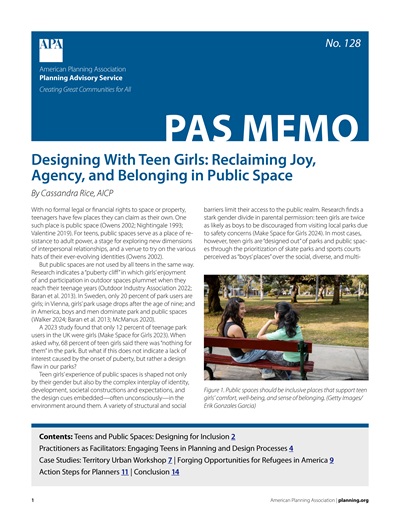
Designing With Teen Girls: Reclaiming Joy, Agency, and Belonging in Public Space
PAS Memo 128
By Cassandra Rice, AICP
Not a member but want to buy a copy? You'll need to create a free My APA account to purchase.
Create account
With no formal legal or financial rights to space or property, teenagers have few places they can claim as their own. One such place is public space. But public spaces are not used by all teens in the same way.
Research indicates a “puberty cliff” in which girls' enjoyment of and participation in outdoor spaces plummet when they reach their teenage years. In Sweden, only 20 percent of park users are girls; in Vienna, girls’ park usage drops after the age of nine; and in America, boys and men dominate park and public spaces. A 2023 study found that only 12 percent of teenage park users in the UK were girls. When asked why, 68 percent of teen girls said there was “nothing for them” in the park. But what if this does not indicate a lack of interest caused by the onset of puberty, but rather a design flaw in our parks?
In many cases, teen girls are “designed out” of parks and public spaces through the prioritization of skate parks and sports courts perceived as “boys’ places” over the social, diverse, and multifunctional spaces that research shows girls prefer. Understanding these dynamics is crucial for planning and designing welcoming, flexible, and meaningful public spaces for teen girls. If a park doesn’t consider teen girls by design and include them in the design process, then it will, by default, be coded and designed in favor of male-centric recreation.
If the built environment is a physical representation of what we value as a society, and who we see in those spaces signals whose perspectives and identities we deem worthy of consideration and inclusion, what does it tell us when the presence of teen girls is limited, or they are simply nowhere to be found?
This PAS Memo examines the importance of an inclusive public realm and explores two case studies that illustrate how practitioners can better engage teens — especially teen girls — in the design process to create public spaces that better reflect their needs, desires, and values. It draws on gender-focused, built environment–centered research conducted by the global architecture firm Perkins&Will, grounded by the Girls Just Wanna Have Fun innovation incubator research project, which examined how public spaces can support teen girls' well-being and sense of belonging. The Memo concludes with a practice toolkit to help planners begin engaging teenage girls more intentionally in the communities where they work.
Details
About the Author
Cassandra Rice, AICP
Cassandra Rice is a Senior Urban Designer at Perkins&Will in Chicago, where she leads multidisciplinary projects that blend data-driven research, spatial analytics, and innovative public outreach strategies. Cassandra’s work spans regional planning in the GCC to local public spaces in Chicago, where she integrates research and data-driven insights to synthesize environmental, economic, and cultural influences to inform gender-sensitive urban design. A strong advocate for participatory planning, she brings dynamic and creative engagement strategies that empower communities to co-create their environments, emphasizing the role of designers as facilitators.
Beyond her practice, Cassandra serves on the executive board for Lambda Alpha International. Passionate about creating a better City of Chicago for everyone, she contributes to Friends of the Chicago River, the Greater Chicago Watershed Alliance, the Metropolitan Planning Agency, and the Avondale Neighborhood Association. In her free time, she explores Chicago’s neighborhoods with her dog, Harlow, indulges in the city’s food scene, and enjoys live music.