


Planning for Uncertainty With Climate Adaptation Pathways
PAS Practical Guidance: Planning in Action 01
By Melissa May, AICP, Alice McLean, AICP, David Revell, Matthew Jamieson
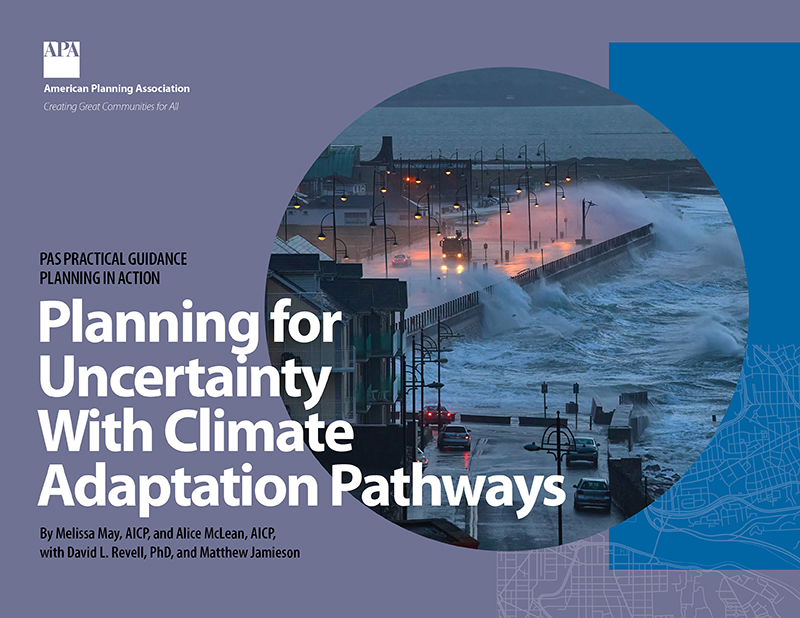
Not a member but want to buy a copy? You'll need to create a free My APA account to purchase.
Create account
Adaptation pathways help communities plan how to respond to the uncertainties of climate change over time by establishing a series of actions with associated triggers and thresholds, allowing them to monitor changing conditions and adjust their approach when those triggers or thresholds are reached.
The adaptation pathways planning process can build community agreement around identifying goals, evaluating strategies and trade-offs, and knowing when it's time to change course, and can be informed by technical analyses and climate science as well as local knowledge and lived experience.
Planners can use adaptation pathways as a flexible, practical planning approach to help their communities take action in the face of uncertainty, connecting long-term resilience goals with near-term decisions about land use, infrastructure, funding, and policy.
This edition of PAS Practical Guidance: Planning in Action explains why pathways are an effective long-term climate adaptation planning framework and provides action steps for planners to begin incorporating this approach in their work.
Details
About the Authors
Melissa May, AICP
Melissa May, AICP, is a principal at Integral Consulting with more than 20 years of experience advancing climate resilience across built environments. She has partnered with state and local planning and infrastructure agencies on a wide range of climate resilience initiatives. She has served as lead planning consultant on 11 APA award-winning projects, three of which received National APA awards.
Alice McLean, AICP
Alice McLean, AICP, is a planner with SSFM International. Her experience spans coastal resilience planning, conservation, ecosystem restoration, and community engagement. In her current role, she has contributed to adaptation plans in response to sea level rise, compound flooding, and heat; policy analysis for climate adaptation, managed retreat, and land use regulations; and long-range community plans.
David Revell
David L. Revell, PhD, is a principal at Integral Consulting with more than 30 years of experience in coastal resilience, adaptation planning, and surf science. His work integrates geomorphology, historic ecology, coastal hazard modeling, and socioeconomic analysis to help communities evaluate adaptation pathways and navigate trade-offs among infrastructure protection, coastal access, beaches, ecosystems, and recreation.
Matthew Jamieson
Matthew Jamieson is a consultant at Integral Consulting. He applies expertise in GIS, coastal hazard analysis, and visual communication to help stakeholders understand future risks, evaluate alternative adaptation options, and identify triggers, thresholds, and implementation pathways. He has supported adaptation planning, sea level rise vulnerability assessments, and resilience initiatives throughout Hawaiʻi and California.