


Complete Streets: The Next Generation
PAS Report 609
By Andrew Crozier, AICP, Angela Biagi, Lisa Nisenson, Eunice Read, AICP
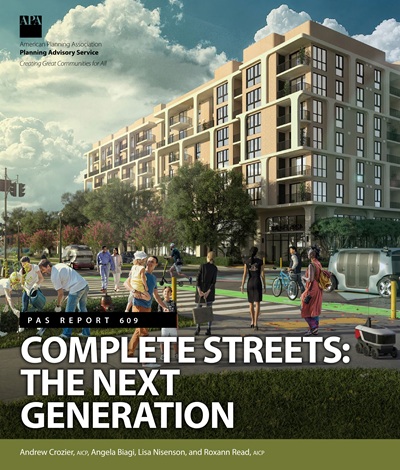
Not a member but want to buy a copy? You'll need to create a free My APA account to purchase.
Create account
The complete streets movement launched in the early 2000s to advocate for accommodating bicycles, pedestrians, and transit alongside cars on our streets. In 2010, APA published PAS Report 559, Complete Streets: Best Policy and Implementation Practices, providing an early look at successful policies and practices from communities across the country. Since then, the number of complete streets programs has grown — and our cities, transportation options, and technologies have undergone substantial change. Now is the time for a new look at the next generation of complete streets.
PAS Report 609, Complete Streets: The Next Generation, offers planners a comprehensive look at what's needed to keep all users safe in today's expanded multimodal transportation landscape against a broader understanding of streets as dynamic, multifunctional public spaces. Drawing from the extensive body of complete streets research and real-world experience of the past two decades, it covers the fundamental components of complete streets and the many community goals they can support.
The report offers guidance on communication strategies needed for robust, inclusive, complete streets community engagement; catalogs today's multiplicity of transportation options and the street design and infrastructure elements that can safely accommodate those modes; and explores new possibilities for programming streets. It outlines data needs and performance metrics for planning and managing complete streets, overviews of funding sources and implementation plans for getting projects built, and emphasizes the importance of monitoring and evaluation for continued program evolution and improvement. Case examples and linked resources throughout make this report a one-stop reference guide for all aspects of complete streets planning, design, and implementation.
Creating safe, complete streets for all users to support equitable, accessible, and sustainable mobility is more important today than ever before. The evolution of complete streets continues to unfold, and planners still have key roles to play in realizing the myriad community benefits of complete streets. Whether their communities are just starting to explore this idea or whether they are fine-tuning a long-standing complete streets program, planners can use the information and guidance provided in this PAS Report to help their communities achieve the next generation of complete streets.
Executive Summary
Since cars began rolling off assembly lines in the early 20th century, street design has been based largely on one mode: the automobile. The complete streets movement — an approach to planning, designing, building, operating, and maintaining streets that enables safe access for all people who need to use them, including pedestrians, bicyclists, motorists, and transit riders of all ages and abilities — emerged to challenge this approach. It has steadily spread across the United States, with the number of complete streets policies growing from less than 60 in 2010 to more than 1700 today.
The practice and evolution of complete streets over the past two decades offer opportunities to update details and incorporate new trends, formulate lessons learned, and undertake course correction. As the number and extent of complete streets programs have grown, so too has the base of research and case studies. This information is valuable not only for evaluating individual projects, but also in continuing to make the case for complete streets.
This PAS Report is a planner's guide to incorporating new recommended practices, lessons learned, and evolving trends into complete streets efforts. Whether readers are just learning about complete streets or managing long-term complete streets programs in their communities, this report will help them better understand how to design and develop transportation infrastructure that accommodates the needs of all road users while achieving a wide range of broader community goals.
The purpose of this report is to present the most up-to-date information on complete streets. It seeks to accelerate the adoption of infrastructure design and operations that support community goals related to mobility, access, equity, the environment, economic vitality, and physical and mental well-being. The report offers guidance to help planners create more inclusive, multimodal, and sustainable transportation networks. It explores how complete streets can continue to meet the changing needs of communities, promote resilience, prioritize safety, and create accessible and vibrant urban environments. Research, resources, and citations are provided throughout the report to provide readers with information and examples from communities across the country and beyond to inform local programs and projects. Appendices provide additional resources for readers.
KEY ELEMENTS OF COMPLETE STREETS
Chapter 2 of this report examines 10 key elements, both traditional topics and emerging issues, that planners must consider when planning, designing, and implementing complete streets:
- Multimodal transportation. The number and types of mobility options have multiplied over the last two decades, adding to the complexity of accommodating all transportation modes within complete streets.
- Complete networks. Complete streets link important destinations through networks composed of blocks, segments, and intersections, a concept that becomes even more important when financial or physical constraints make it impossible for all streets to incorporate infrastructure for all modes.
- Context. Context was initially defined in terms of land use and intensity, but this concept has evolved over the last decade to encompass socioeconomic, environmental, and cultural elements.
- Safety. Complete streets must continue to create safer conditions for pedestrians and cyclists while incorporating safety measures for new mobility options, including e-bikes, e-scooters, delivery drones, low-speed shuttles, and autonomous vehicles.
- Equity and access. Complete streets must provide all users with mobility options they can access and use to get to and from important destinations, regardless of ability, car ownership, or financial status.
- Economic development. Years of implementation have shown that complete streets produce tangible economic benefits, including higher property values, more foot traffic, higher employment levels, better access to opportunities, increased retail spending, and reduced transportation costs.
- Environment and climate. Complete streets are an important tool in reducing pollution and building community resilience to the impacts of climate change, from decarbonizing transportation by supporting walking, biking, transit, and vehicle electrification to incorporating green infrastructure elements and mitigating extreme heat.
- Public health. Complete streets promote physical activity and mental health in daily life by making walking and biking safer, more inviting, and more accessible. Recent years have also shown that streets can help communities respond to public health emergencies.
- Technology. New visualization, data management, and communications technologies can augment complete streets planning, design, analysis, and public outreach processes, but planners must critically evaluate emerging technologies and tools against their potential risks.
- Programming and management. Streets are more than static physical infrastructure. Flexible design and programming allow streets to meet a wider array of community goals and provide benefits beyond mobility.
ENGAGEMENT AND COMMUNICATIONS FOR COMPLETE STREETS
Public engagement is a cornerstone of complete streets. Because roadway design and function affect a multitude of stakeholders, planners must employ robust and equitable public engagement processes that consider a community's full range of concerns, issues, needs, and solutions.
Chapter 3 of the report explains the importance of public engagement in successfully implementing complete streets programs and projects. It covers the evolution of public engagement, legal requirements for engagement, the shortcomings of conventional public outreach approaches, and steps to overcome exclusionary practices. It explores how to identify and analyze stakeholders and how to create messaging and engagement strategies and techniques. It shares recommended practices, research, guides, toolkits, and templates addressing effective, efficient, and equitable ways to conduct public engagement for complete streets. Finally, it describes recommended practices for recording and reporting on public engagement efforts. Appendices A and B of the report offer a collection of talking points and additional references to help planners make the case for complete streets in their communities.
COMPLETE STREETS POLICIES
Successful complete streets policy outcomes encompass more than concrete and asphalt. With heightened attention to mobility and access, planners can link an array of community goals to the design and operation of streets. Key elements of effective complete streets policies include prioritizing projects in communities lacking multimodal infrastructure investments, applying complete streets designs to all new or reconstruction projects, limiting exceptions, mandating coordination, adopting the latest and best design criteria, and linking streets and land use.
Chapter 4 of the report describes the general aspects of policy and policy-setting for complete streets. It looks at how complete streets policies have evolved over the past two decades as changing conditions, critiques, and ever-increasing crash rates have affected active transportation and forced a reevaluation of the traditional approach to complete streets policy and implementation. This chapter provides an overview of the elements of complete streets policy as defined by the National Complete Streets Coalition and highlights notable complete streets policy examples at the state, regional, and local levels.
MULTIMODAL PORTFOLIO
The quest for complete streets began with a short list of transportation modes: driving, walking, biking, and transit. Today, that list has expanded to encompass a wide range of new mobility options. Planners and engineers need to consider how all of these modes will function and interact within complete streets when designing roadways that ensure the safety and effectiveness of these mobility systems. In addition to new modes, travelers have new alternatives for trip-making through shared-use mobility, fleets, and new transit service lines, such as microtransit. These new offerings affect infrastructure by changing travel patterns in ways such as altering demand for parking and increasing demand for pick-up and drop-off areas.
Chapter 5 reviews a taxonomy of transportation modes — pedestrians, personal and shared motorized vehicles, micromobility, minimobility, delivery vehicles, and transit vehicles — and explains their implications for complete streets programs, and it describes how different mobility choices can be prioritized by establishing mode hierarchies.
STREET DESIGN AND INFRASTRUCTURE ELEMENTS
Complete streets are, as the name implies, largely about infrastructure. Working with engineers, planners can assist in choosing projects that provide the right infrastructure in the right place and influence options that link context, mobility, and land use. Design standards and guides establish the possibilities, and planners should also consider street typologies and network approaches that affect roadway infrastructure. Complete streets alternatives are often optional, and traffic and transportation engineers may feel obligated to use standard practices to avoid risk. In such cases, planners need to be conversant to some degree in technical design to make the case for complete streets. With an understanding of the guidance and contexts that shape infrastructure, planners can play a constructive role in the choice, location, and design of complete streets components.
Chapter 6 describes the major complete streets infrastructure elements — sidewalks, roadways, intersections and crossings, and bikeways — and provides real-world examples of those elements, along with additional resources for further guidance.
PROGRAMMING STREETS
Today's complete streets are not a static resource, but an asset that can be managed dynamically in real or near-real time. Programmable streets optimize the changeability and use of travelways, curbsides, and sidewalks. Tools such as flexible street design standards, innovative community planning techniques, modular infrastructure, and new technologies allow planners to schedule use changes, manage traffic operations, and reconfigure space.
Chapter 7 introduces the new paradigm of multimodal, multiuse programmable streets and their design, finance, and operations. It explores engineering and design standards that support flexible use and enable temporary, iterative alteration of physical parameters, as well as programming streets for different uses using physical, financial, and technological tools.
DATA PLANNING AND MANAGEMENT
Data systems and emerging technologies represent a new facet of complete streets planning and programming. Their evolution has expanded planners' abilities to evaluate how a transportation system is performing based on the community's expectations of its mobility system. The increased infusion of data into planning processes, however, brings risk. Topics of concern that merit deeper discussion within planning practice include identifying and correcting discrimination and bias within datasets and algorithms, the ethical concerns of artificial intelligence (AI) in planning, and obligations to safeguard data protection and privacy.
Chapter 8 provides an overview of the role of data in complete streets projects, the elements needed to establish or improve a data program, the use of data for complete streets projects, and how complete streets policies might overlap with performance-based planning. The spotlight on performance elevates the role data and metrics play in planning and monitoring complete streets. Appendix C of the report compiles performance metrics and data sources relevant to transportation, infrastructure, access and accessibility, equity, and climate goals for complete streets.
FUNDING COMPLETE STREETS
Among the biggest challenges to realizing the myriad benefits of complete streets is funding their construction. Over the past two decades, the funding landscape for complete streets projects has evolved as awareness of multimodal transportation and community-centered design has grown, though recent years have seen wide fluctuations in federal support. State and local governments fund projects identified through complete streets policies and plans, and nonprofits and public-private partnerships also provide funds for complete streets through community development agreements and grants. Projects that address factors such as safety, accessibility, and community transportation goals are now being prioritized within funding documents.
Chapter 9 provides a primer on how complete streets are funded and offers an overview of federal, state, regional, and local funding sources for complete streets projects at the time of this report's publication, with the caveat that current funding uncertainties are likely to persist. It also explains the role of planners in identifying, applying for, and managing funding streams for complete streets projects.
IMPLEMENTATION AND MONITORING
Implementation is the culmination of the complete streets program development and project initiation. Successful implementation begins with complete streets policies that detail public involvement and process. It can be achieved by establishing a complete streets program to oversee stakeholder and team management, internal and external engagement, policy adoption and updates, planning, project implementation, and program monitoring.
Chapter 10 focuses on the importance of complete streets programs in creating a structure for effective complete streets implementation. It examines the process required to plan and deliver a complete streets project and offers guidance on the rapid implementation of demonstration and quick-build projects as an alternative approach. Finally, the chapter discusses the role of monitoring and evaluation in determining the success of a complete streets program and guiding its evolution and improvement.
THE FUTURE OF COMPLETE STREETS
Over the last two decades, the complete streets movement has reshaped transportation and community planning by expanding the inclusion of multimodal transportation into infrastructure planning, design, and performance goals. Creating safe, complete streets for all users to support equitable, accessible, and sustainable mobility is more important today than ever before. The evolution of complete streets continues to unfold, and planners still have key roles to play in realizing the myriad community benefits of complete streets.
Planners are essential to complete streets because complete streets are more than roadways, curbs, and sidewalks. They encompass safety, access to destinations, robust engagement, and stewardship of the public interest — interlinked topics that planners address every day. Equity, climate resilience, and active transportation will remain core community concerns, no matter the political climate. Planners can connect these local goals to infrastructure and transportation systems. They have the skill sets for creating complete streets programs that integrate mobility, access, health, equity, environmental protection, economic development, and other locally important issues. They can encourage their engineering colleagues to make use of the flexibility written into updated roadway standards and guidance, and they can provide constant reminders that streets are so much more than just spaces for automobile movement and storage.
This PAS Report is a comprehensive resource for planners helping their communities envision the future of complete streets and realize goals that transform infrastructure projects into community assets. Whether they are just starting to explore complete streets or are fine-tuning a long-standing complete streets program, planners can use the information and guidance provided in this report to help their communities achieve the next generation of complete streets.
About the Authors
Andrew Crozier, AICP, has over 10 years of experience in planning and urban design, spanning the municipal, federal, and private sectors. As a senior urban designer with WGI, he has worked on mobility initiatives, complete streets, placemaking, comprehensive planning, and urban design projects nationwide.
Angela Biagi, PLA, LEED BD+C, is the director of planning at WGI and leads the firm's strong focus on design excellence and complete streets. With 25 years of experience in landscape architecture and planning, she brings a design-forward approach to shaping streets, corridors, and public spaces that prioritize safety, mobility, and placemaking.
Lisa Nisenson has 25 years of experience in innovating land use and mobility planning at the national, regional, and local levels. A pioneer in new mobility and an industry leader in future-forward urban and transportation planning, at WGI, she leads development of next-generation planning, smart city technology strategies, emerging mobility, autonomous vehicles in transit, and integrated placemaking.
Roxann Read, AICP, has 15 years of experience in the planning field, having worked for local governments in Florida and Missouri in both long-range and current planning. She currently serves as chair of the Orlando Metro Section within the Florida Chapter of the American Planning Association and was awarded the Distinguished Contribution to the Chapter award in 2020 and 2022.
You May Also Like


Product Details
Table of Contents
Executive Summary
01 The Evolution of Complete Streets
About This Report
02 Key Elements of Complete Streets
Multimodal Transportation
Complete Networks
Context
Safety
Equitable Access
Economic Development
Environment and Climate
Public Health
Technology
Programming and Management
Conclusion
03 Engagement and Communications for Complete Streets
Preparing for Public Engagement
Stakeholder Identification and Analysis
Messaging
Engagement Techniques
Public Input Reports
Conclusion
04 Complete Streets Policies
The Evolution of Complete Streets Policies
Complete Streets Policy Guidance
Conclusion
05 Multimodal Portfolio
Modes
Mode Prioritization
Conclusion
06 Street Design and Infrastructure Elements
Street Design Factors
Complete Streets Infrastructure Elements
Conclusion
07 Programming Streets
An Introduction to Programming Streets
Ways of Programming Streets
Conclusion
08 Data Planning and Management
The Role of Data in Complete Streets Projects
Elements of a Data Program
Conclusion
09 Funding Complete Streets
Funding 101
The Planner’s Role in Complete Streets Funding
Conclusion
10 Implementation and Monitoring
Building and Implementing a Complete Streets Program
Implementing a Complete Streets Project
Monitoring and Evaluation
Conclusion
11 The Future of Complete Streets
The Planner’s Role in Complete Streets
A Look Ahead
Achieving the Next Generation of Complete Streets
Appendix A. Making the Case for Complete Streets
Appendix B. Complete Streets Resource Compendium
Appendix C. Complete Streets Metrics and Datasets
References
Acknowledgments