


Spotlight on Zoning Practice
Could Accessory Commercial Units (ACUs) Help Fill the Missing Commercial Middle?

Summary
- Accessory commercial units (ACUs) allow small-scale businesses to operate in a public-facing way from residential property.
- Like accessory dwelling units, ACUs can be inside of, attached to, or detached from a residence on the same lot.
- Successful zoning for ACUs relies on a clear understanding of resident expectations and business needs.
Since the1950s, planners and local officials have routinely used home occupation zoning standards to define permissible uses of residential property for business purposes. For decades, these standards typically prohibited businesses where clients or customers visited the home. But now, momentum is on the side of home occupation zoning reform efforts that acknowledge the changing nature of work and aim to reduce barriers to entry for homegrown businesses. In fact, some states have limited local zoning authority for home occupations, most recently in Texas (HB 2464, 2025).
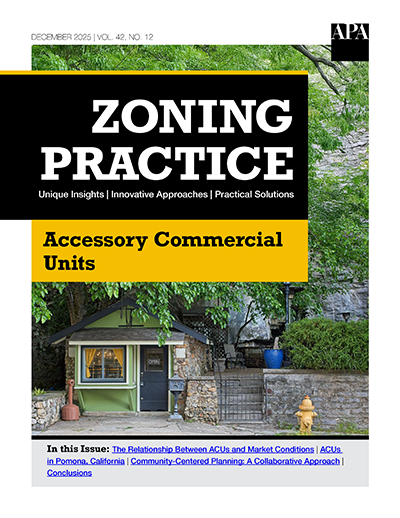
If you zoom out a bit, you can even see this policy shift as one facet of a larger conversation about recalibrating zoning to support businesses at all stages of development. As Bobby Boone, AICP, and Max Pastore note in the December issue of Zoning Practice, "Accessory Commercial Units," many early-stage entrepreneurs have space needs that fall somewhere between a home occupation and "main street" commercial. And much as accessory dwelling units (ADUs) can help fill the missing middle in housing, accessory commercial units (ACUs) may do the same for commercial uses.
ACUs Are More Than Corner Stores
If you walk around many older U.S. cities, you may notice current and former commercial spaces sprinkled throughout residential neighborhoods. These spaces typically occupy a portion of the ground floor of (or are attached to) a larger residential structure. In zoning terminology, they are accessory uses or structures to principal residential uses.
Often, these spaces predated zoning, and as cities embraced zoning regulations that enshrined a strict separation of uses following World War II, their tenants became nonconforming uses. In recent decades, planners and local officials have relegalized commercial uses in some of these spaces through zoning reforms that authorize lightly mixed-use districts. While these spaces exemplify ACUs in a traditional urban context, what might ACUs look like in newer cities?
Boone and Pastore frame ACUs as a more flexible category than a corner store or ground-floor storefront in a vertically mixed-use building. This is why the ADU analogy fits. They suggest both ADUs and ACUs can be inside of, attached to, or detached from a residence. In fact, as Boone and Pastore note, Raleigh, North Carolina, captures this idea to a T by authorizing ACUs to occupy any ADU on a residential lot (§6.73.3.E).
ACUs Are for Entrepreneurial Neighbors
Many of us still have a romantic attachment to the idea of a shopkeeper living in an apartment above their storefront. However, this is far from the default condition, even in most main-street-style neighborhood commercial districts. Consequently, neighborhood-serving business owners may be neighborly but aren't necessarily residents of the neighborhood.
Boone and Pastore stress that ACUs are just one way to broaden opportunities for small businesses. However, they do play a distinct role in the local business ecosystem: ACU tenants are typically (or by definition) neighborhood residents. Generally, they want to meet neighborhood needs while also being a good neighbor.
According to Boone and Pastore, community collaboration is crucial for successfully enshrining ACUs in zoning. And it's crucial for community acceptance of the actual conversion or construction and occupancy of ACUs. Boone and Pastore say this collaboration begins with a clear understanding of community perceptions about appropriate business uses of residential property and a clear sense of how much physical change is tolerable to satisfy business needs.
Subscribe to Zoning Practice
Each issue of Zoning Practice provides practical guidance for planners and land use attorneys engaged in drafting or administering local land use and development regulations. An annual subscription to ZP includes access to the complete archive of previous issues.
Top image: SolStock / E+