
Federal Impacts
Planning Win: Housing for the 21st Century Bill Passes the House
Planning advocates celebrate an early win with passage of the bipartisan Housing for the 21st Century Act out of the House.

summary
- The House of Representatives has passed the Housing for the 21st Century Act, reaffirming momentum for federal action on housing.
- Housing 21 is similar to the Senate's ROAD to Housing Act in supporting planners with federal resources to reform local zoning regulations.
- Housing 21 includes a new grant program, streamlined environmental review processes, national guidance on zoning and land-use, improved federal housing programs, and more.
- The bill is not yet enacted; Congress must reconcile the differences between the Senate's ROAD to Housing and the House's Housing 21.
The Housing for the 21st Century Act (Housing 21) was initially passed out of the House Financial Services Committee in December, and prior to its passage out of the full House of Representatives, new provisions were incorporated into the bill. It passed in a sweeping vote of 390-9 on February 9, 2026, reaffirming momentum for action on housing at the federal level.
This APA-endorsed bill is similar to the Senate's Renewing Opportunity in the American Dream (ROAD )to Housing Act, and both include promising support for planners working to reform outdated zoning and expand housing options in our communities. However, the differences between ROAD to Housing and Housing 21 will now need to be reconciled by Congress before a final bill is enacted.
Planning-Related Measures in Housing 21
Here are some of the major planning-related measures in Housing 21 and some key differences between this bill and ROAD to Housing:
HOME Program Updates
Like the Senate's ROAD to Housing bill, Housing 21 aims to update the HOME Investment Partnerships (HOME) program. Among the changes included:
- Expanded eligibility to participate in the HOME program
- Improved flexibility for using HOME funding
- Streamlined NEPA review to remove duplicate requirements and expand exemptions
New Grant Program at HUD
Housing 21 creates a grant program to implement planning and community development activities. Similar to the existing HUD PRO Housing program, this would essentially serve as authorization for grants aimed at supporting reforms and plans.
Improvements to the Rural Housing Service Program
Planners in small towns and rural communities are working hard to increase housing supply, but often face challenges in planning capacity, old zoning codes, and a lack of funding. Housing 21 includes improvements to Rural Housing Service programs, such as expanding access to USDA loans, which will help ease the burden on rural communities.
New Models and Research
Both ROAD to Housing and Housing 21 include guidance, models, and research for zoning and land-use reforms. Planners have long advocated for an appropriate federal role in supporting local planning efforts, and providing access to data and best practices is exactly the kind of support that will enable low-capacity and high-capacity communities alike to advance right-size solutions to increase housing abundance.
The Housing 21 bill also directs the Government Accountability Office (GAO) to conduct studies on middle-income housing and residential building codes. This research will shine a light on common barriers to housing production and affordability, and how federal housing programs might improve support for middle-income housing efforts.
Single-stair guidelines
Modernizing building codes through single-stair legislation is a growing trend at the state level, so its inclusion in Housing 21 is only fitting. "Smart stair" reform can lower construction costs, improve safety, and expand the types of housing available.
Housing 21 directs HUD to establish guidelines for point-access block buildings, which will help states and localities to permit residential buildings with a single internal stairway for up to five stories.
Additionally, the bill encourages HUD to award competitive grants for projects testing the safety, feasibility, or effectiveness of single-stair multifamily buildings.
Streamlining Environmental Reviews
Another area of priority in both the Housing 21 and ROAD to Housing bills is targeted streamlining of environmental reviews to speed housing production.
Housing 21 expands categorical exclusions in NEPA review to reduce delays. It also directs HUD and the USDA to coordinate environmental review processes and regulatory requirements.
Manufactured Housing
Both Housing 21 and ROAD to Housing eliminate the permanent chassis requirement for manufactured housing. Measures like this will help planners to reduce barriers to innovative housing solutions.
Manufactured housing is a growing trend and can be another approach to reliable and cost-effective home-building at scale.
A Policy Priority Win
Housing clearly continues to be an area of strong bipartisanship, and one where Congressional action can have an immediate impact on the resources, funding, and assistance available to planners who are working to reform zoning regulations that discourage housing development.
That's why increasing housing supply through zoning reform is one of planners' top policy priorities in 2026.
APA's 2026 Policy Priorities
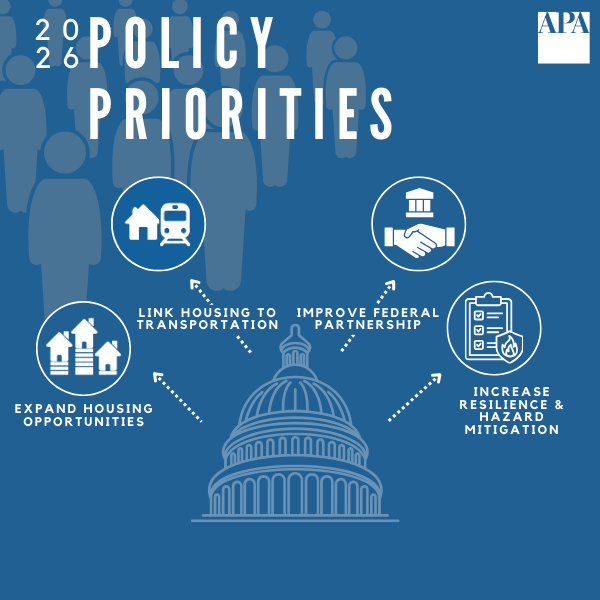
Federal action strengthens local planning
Housing, transportation, resilience, and federal partnership — see how federal action in these four priority areas can help support locally-led planning efforts in communities across the country.
"To me, the root of our profession is advocating for what we believe will improve our communities," said Ed LeClear, AICP, Planning and Community Development director of State College, Pennsylvania. "We have responsibilities to understand how changes can be made that will improve our community."
LeClear joined other planning advocates on Capitol Hill to tell Congress why federal support through legislation like the Senate's ROAD to Housing Act and the House's Housing for the 21st Century Act would bring much-needed support to communities like State College and beyond.
"I think it's two things in terms of support that the federal government can provide," said LeClear. "Are there ways to change the rules that will help local governments improve their communities and their citizens' lives? Secondly, are there programs and funding sources that can be better allocated?"
The Housing for the 21st Century Act is a promising step toward providing planners with that federal support. In the meantime, APA will continue to work with advocates like LeClear and federal representatives to push for federal resources that empower local planning efforts.
Demystifying advocacy
Hear more from Ed LeClear, AICP, and other advocates on why policymakers need planners' perspectives at the table to advance housing solutions.
Top Image: iStock/Getty Images - benedek