


Data Centers and the Future of Economic Development
Summary
- Data center development is a highly contentious local economic development issue.
- New large-scale data centers may amplify or mitigate five key challenges for the future of economic development, and they share features with other large-footprint land uses that also sparked widespread concerns when new.
- As planners and other economic development practitioners work to balance the tradeoffs between land use impacts and economic benefits of data centers, they will also need to contend with deep uncertainties about the future of AI.
Perhaps the single most contentious local economic development issue today is whether to embrace or impede hyperscale data center development. Boosters note that data centers generate substantial economic activity during construction, contribute far more local revenue than they consume in public services, and provide a not-insignificant number of new permanent jobs. Critics say that data centers consume too much land, power, and water and provide too few permanent jobs to be a good deal for host communities.
However, data center development is not happening in a vacuum. The first post in this series highlighted five key challenges for the future of economic development. Each of these challenges is relevant to local debates about data centers and economic development. Furthermore, while data centers are a new use for many communities, they certainly aren't the first large-footprint land use to spark widespread concerns. Finally, there are some deep uncertainties about how artificial intelligence (AI) will affect local economies that color the data center debate.
Data Centers and Economic Development Challenges
AI-related automation, e-commerce and remote work, declining birth and immigration rates, renewed efforts to limit property tax collections, and escalating costs from climate change all represent serious challenges to the economic development status quo. Local data center development has the potential to either amplify or mitigate the effects of each of these challenges.
AI-Related Automation
AI companies use data centers to train and deploy their models. While the CEOs of just a few leading AI laboratories wield enormous influence over what types of AI tools get built and for what purposes, they need a powerful and extensive network of data centers to implement their visions. By extension, the pace of AI-related automation depends, among other things, on the pace of data center construction.
E-Commerce and Remote Work
Online retailers need data centers to run their websites and coordinate logistics, and remote workers rely on data centers to store files and provide cloud-based services. Therefore, data center development is also a limiting factor in the continued growth of e-commerce and remote work and their effects on local land markets, employment, and tax bases.
Declining Birth and Immigration Rates
The low permanent employment demands of data centers may make them a good fit for communities facing a declining working-age population. Places experiencing sustained job and population loss could, understandably, view data center development as their best option for generating tax revenue to pay for public facilities and services that support a high quality of life.
Property Tax Revolt (Redux)
Some states offer partial property tax exemptions (or other tax incentives) for data center development that decrease local revenue potential. This effect could be amplified by new caps on residential or commercial property tax collections. Even though large-scale data centers seldom satisfy the standard "but-for" test for subsidies, some communities may feel stuck between trying to negotiate the best deal possible or watching a data center developer choose a site in a neighboring jurisdiction that will have spillover negative land use impacts.
Climate Change Costs
Climate risks could be a powerful constraint on site selection and facility design for new data centers. Data center developers will likely be increasingly sensitive to the hazard risk profile of future potential sites, leading to an intensification of development demand in areas that have lower risks. There is also a possibility that climate change costs could motivate data center owners to abandon existing data centers after disasters or if they can no longer secure insurance coverage for operations.
Data Centers and the Legacy of Large-Footprint Land Uses
Since the late 1980s, a series of new large-footprint land uses have become powerful symbols of major economic shifts in the U.S., often serving as lightning rods for local debates over economic development activities. The hyperscale data center campus is just the latest, though arguably most emblematic, example.
Big-Box Retail
First, large-format retailers, like Walmart, expanded to small and medium-sized communities across the U.S. These expansions created hundreds of new, mostly low-wage jobs in each community but also put many established small retailers out of business. And in some communities, expanding retailers capitalized on high unemployment rates due to deindustrialization to win community support. However, this dramatic shift in the retail environment and the built form of many communities triggered a major backlash and led to a wave of planning, zoning, and economic development reforms.
E-Commerce Warehouses
Next, in the 2010s, major e-commerce companies, such as Amazon, started rapidly scaling their construction of large distribution and fulfillment centers in strategic locations in or near metropolitan areas throughout the country. Again, these facilities provided hundreds of new, mostly low-wage jobs. However, they are often much larger and less job dense than the big-box stores they have begun to replace. Furthermore, their dependence on heavy trucks and other commercial vehicles makes them less compatible with nearby residential development. As with big-box stores, these facilities represent both major changes to local economies and the built environment and, in some places, have experienced similar (if not greater) levels of community opposition.
Large-Scale Renewable Energy Facilities
Then, in the 2020s, technological improvements and favorable state and federal policy environments led to significantly higher demand for large-scale solar, wind, and battery energy storage facilities in many parts of the country. The footprint of most new facilities is much larger than even the largest e-commerce warehouse campuses, and they provide very few new permanent jobs. In many communities, local opposition to new large-scale renewable energy projects is tied to worries about changing community appearance or a loss of community identity, potential environmental impacts, and negative effects on residential property values.
Insights for Data Center Development
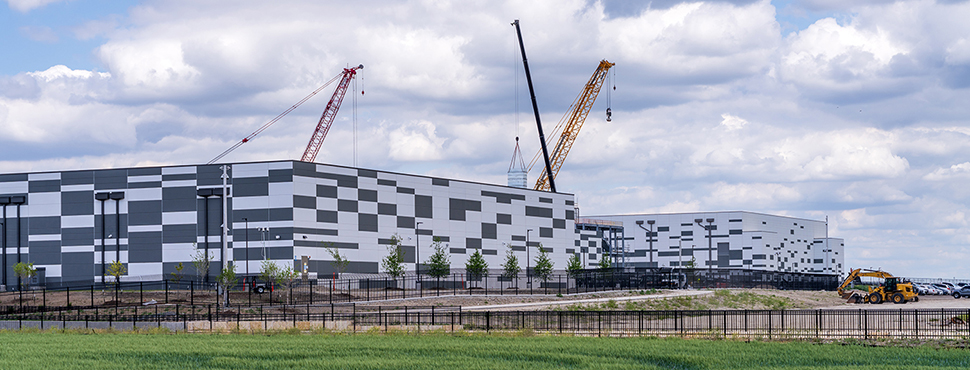
Each of these once-novel large-footprint land uses may offer some insights into why hyperscale data center development is often so contentious. Like big-box stores and e-commerce warehouses, hyperscale data centers typically occupy enormous boxy structures that stand out in the landscape. Like large-scale renewable energy facilities and e-commerce warehouses, they are not very job dense. Like large-scale renewable energy facilities, they need access to electricity transmission infrastructure and very large parcels of open land.
Crucially, each of these uses symbolizes an important economic transition: from mom-and-pop stores to global supply chains, from in-person shopping to shopping from home, from highly centralized (dirty) power generation to highly distributed (clean) power generation, and from human-driven innovation to AI-driven innovation.
Data Centers and Deep Uncertainties
Data centers have been around for decades. They come in all shapes and sizes, and they make the modern internet possible. What is new is the dramatic increase in demand for new hyperscale data centers. While any rapid physical change in communities is likely to spark a backlash, this change is intertwined with a set of deep uncertainties about the future of AI and its effects on local economies.
Will the AI "Bubble" Pop?
According to an analysis by The Wall Street Journal, projected capital expenditures by Alphabet, Microsoft, Amazon, and Meta alone in 2026 are on pace to equal 2.1 percent of the U.S. gross domestic product (GDP). To put this in perspective, average annual spending on railroads in the 1850s was 2.0 percent of GDP, and average annual spending on the interstate highway program between 1955 and 1970 was only 0.4 percent of GDP.
So far, though, investments in AI-related data centers have not led to profits for the AI industry. And the race to build as fast as possible has fueled speculation about a data center bubble. If the bubble pops, it could leave many communities saddled with vacant facilities. But even if it doesn't pop, the short-term macroeconomic effects include higher rates of inflation and less capital available for all other forms of place-based investments.
Will the Backlash Fever Break?
Large data centers have lost their social license. Rightly or wrong, many community members view fights over local data center development as battles over the future role of AI in our lives. This climate makes it very difficult for planners to keep community conversations focused on the tangible costs and benefits of local data center development proposals or scenarios.
Researcher Andy Masley has likened the data center backlash to a moral panic. Many of the most widely circulated claims about the environmental effects of AI and the extreme negative impacts of data centers on host communities don't hold up to close scrutiny. That isn't to say that data centers don't have negative externalities but, rather, that those externalities are (1) less severe than they are often portrayed and (2) shared by many other permissible land uses. Furthermore, new data centers can generate significant tax revenue, and local communities could use this revenue to provide broad-based local benefits. While one-off data centers in rural areas may not have much of an effect on permanent employment or local spending, the multiplier effects of data center clusters are significant.
Is AI a "Normal" Technology?
The long-term economic effects of AI-related data centers depend largely on whether AI remains a normal technology or achieves artificial superintelligence.
The AI-as-normal-technology view contends that diffusion across the economy will be slow, and we'll have opportunities to learn how to leverage AI tools to augment human jobs rather than replace them. In this scenario, data centers remain a normal land use, and the local challenge is balancing local costs and benefits.
However, if policymakers don't step in to place limits on AI deployment, one or more AI companies may develop self-improving models and AI-enabled robots that eventually supersede human abilities in all domains. Taken to a logical extreme, human labor would be economically unnecessary. Then we'd truly be in sci-fi territory.
Knowledge Gaps
So far, local efforts to capture economic benefits and minimize negative effects of data center development have been predominantly reactive. Local development review processes provide a forum for planners to evaluate the consistency of specific proposals with adopted plans and standards, and one-off negotiations with developers can help communities secure benefits. But these approaches are not substitutes for proactive planning.
Currently, though, there are several important knowledge gaps limiting our ability to carry out sound economic development planning for data center development:
- To what extent are regional economic development agencies and organizations using their comprehensive economic development strategies to establish a clear shared prosperity vision for data center development?
- What transferable economic development lessons can we learn from previous experiences with large-footprint development projects?
- How should local and regional planners factor deep uncertainty into their evaluation of the economic benefits and tradeoffs associated with specific large-scale data center development proposals?
APA has identified data center development as a priority issue area for our exploratory research on the future of economic development. And we have already started gathering information and engaging experts to help us work through the questions above. Join us on September 10, 2026, for a webinar on navigating the challenges of data center development.
Top image: © Steveheap | Dreamstime.com