

June 25, 2026
Shade is one of the most effective interventions for reducing the effects of heat on the human body and environment. It can be life-saving infrastructure, since research has found that shade reduces the temperature people feel more than any other single environmental modification. Because of this, both built and vegetative shade should be a priority.
The urban heat island (UHI), where urban areas are hotter than surrounding areas, may be the most common way to conceptualize this, but it fails to capture localized, pedestrian-level conditions that determine whether residents are thermally comfortable, limiting its applicability as a guide for actionable planning. Instead of simply targeting overall UHI reduction, a localized focus on thermal comfort indicators — particularly shade — is needed to design more effective and equitable heat resilience strategies.
Heat mitigation and management traditionally have not been at the forefront of planning priorities, and shade-specific infrastructure interventions even less so. When communities do plan for heat, they often focus on trees or other vegetation.
When it comes to providing shade for people, though, trees have important limitations, including intensive maintenance requirements and water constraints that limit canopy scalability. Canopy programs also do not always reach communities facing the greatest heat burdens. Focusing exclusively on trees may miss opportunities to improve residents’ thermal comfort through building design or shade structures, especially where vegetation-based solutions are most constrained.
Ultimately, protecting people from extreme heat requires local governments to prioritize upgrades to public infrastructure that puts the right shade in the right place.
PAS Report 600, Planning for Urban Heat Resilience, coauthored by Ladd Keith, PhD, and Sara Meerow, PhD, provides guidance for planners on strategies for urban heat resilience.
6 tools to prioritize shade in planning efforts
At least one major U.S. city is making strides in mitigating urban heat effects. Phoenix is the hottest large city in the U.S. and is at the forefront of heat planning. The city’s first-of-its-kind Office of Heat Response and Mitigation developed the first comprehensive shade plan in 2024. This new plan, which replaced Phoenix’s 2010 guidance, approaches the problem with an innovative framework, highlighting vegetation and built shade — with the goal of making people more comfortable in their day-to-day lives.
Drawing from our experience in developing and researching the Shade Phoenix Plan, here are six strategies to incorporate shade into other communities’ work.
1. Prioritize people first
Target actions where they have the greatest impact on human health and overall well-being. The Shade Phoenix Plan prioritizes people by implementing a framework and rationale for decision-making that emphasizes human experience rather than overall canopy targets. The plan empowers planners to spend more per tree and more per project, and do the more complicated projects if that is what will benefit residents the most.
The plan also leverages survey data about where community members think the most and least shaded spots are, adds shade structures at bus stops, and prioritizes investments in high-traffic “cool corridors.
2. Use the correct data
Shade is an investment for people, so using proper data is important. High-resolution data to understand thermal conditions at the pedestrian level is becoming more accessible. Publicly accessible tools like the Tree Equity Score (TES) maps include a layer for shade estimates at noon, 3 p.m., and 6 p.m. The TES shade data provides helpful information about areas that need more shade by providing the correct scale for pedestrian-level planning.
3. Define shade as critical infrastructure
Shade should be designated as a critical community resource, like other infrastructure types, such as water, power, and transportation. By classifying shade as an essential utility, cities and planners can be better at establishing funding, maintenance, and management practices required to sustain shade assets, which can include trees, shade structures, and buildings.
The Shade Phoenix Plan includes guidance for incorporating shade into the urban fabric and site design standards by land-use type, along with funding guidelines for prioritizing shade.
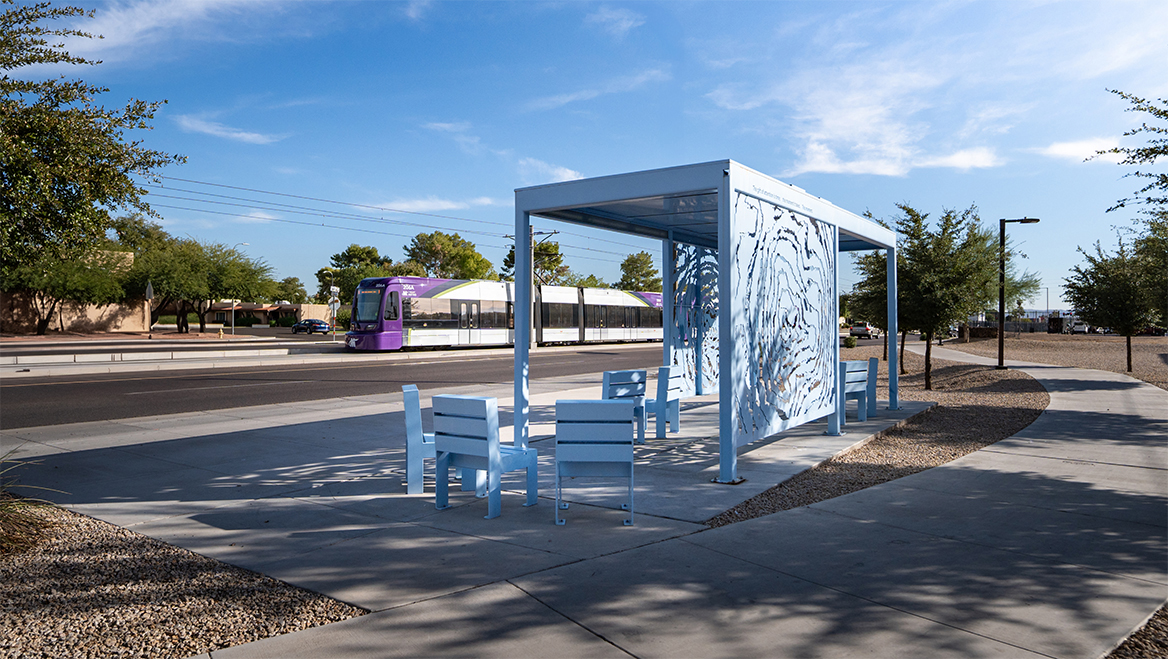
The Phoenix Office of Arts and Culture partnered with an artist team, an elementary school, and city departments to design this transit shelter that improves visibility, ADA access, and shade. Photo courtesy of City of Phoenix.
4. Lead with an Equity lens
Increasing shade is imperative in the hottest areas of a city, which are more likely to be under-resourced. To address historical injustices, it is crucial to invest in and target areas that have been historically underserved. The Shade Phoenix Plan prioritizes low- and mid-low-income neighborhoods for planting projects and built shade.
5. Foster multi-sector collaborations
Building more resilient cities requires cross-sector engagement. Working within city government, between public and private actors, with researchers, and with the communities is imperative to put shade investments in the foreground where they are needed most. Collaboration among these groups ensures infrastructure responsibility is shared among city departments, includes practices to increase shade on private land, provides the most up-to-date data and methods, and considers community needs.
The Shade Phoenix Plan includes a strategy to re-establish a cross-departmental working group on urban forestry and create a new built shade working group. Because of the nature of shade investments, many stakeholders are involved in implementation and maintenance. For example, streetscape shade investments may include public works, streets and transportation, and planning and development to fulfill the siting requirements, maintenance, and proper zoning.
6. Go beyond the status quo
Changing our climate trajectory requires innovation and a willingness to take risks. To make shade a priority, planners must move beyond standard practices and experiment with new materials, zoning mandates, and new designs to drastically increase shaded areas. By challenging historical planning norms, we can transform the urban landscape into a more resilient environment for the future.
One way the Shade Phoenix Plan does this is by developing city-owned building design standards and ensuring they align with the goals of the plan by establishing a facility review committee.
RECOMMENDED ARTICLES