
Spotlight on Zoning Practice
Opening Doors for Microbusinesses

Summary
- Microbusinesses offer unique services, encourage community connections, and promote economic opportunities; however, complex zoning regulations can introduce significant hurdles to establishing and maintaining these businesses.
- Authorizing accessory commercial uses for community-serving entities can expand the supply of flexible and affordable spaces to operate microbusinesses.
- Adjusting nonconforming use regulations can better support microbusinesses by reducing restrictions that can limit growth.
Microbusinesses may be small in operation but their influence on communities and local economies isn't. In fact, according to the U.S. Census Bureau, most businesses in the U.S. have fewer than 10 employees, and microbusinesses employed over 14 million people in 2023 and accounted for 3.2 million new jobs. These businesses range from online retailers to home-based services to traditional, brick-and-mortar, mom-and-pop shops. And they reflect the various unique goods and services our community members have to offer, fostering connections and familiarity.
Despite the benefits that microbusinesses bring to communities, complicated zoning regulations can pose significant challenges to growing and establishing these businesses. In the September issue of Zoning Practice, "Saving Mom and Pop Shops and Making Room for New Kids on the Block," Jane Dixon, AICP, and Ashley Jankowski, AICP, discuss how planners can help update zoning codes to better support opportunities for microbusinesses. Adopting regulations that remove barriers for microbusiness owners can promote balanced and connected neighborhoods and encourage economic growth.
Locating Opportunities
Finding a location to operate a business can be challenging, especially for first-time business owners and those with limited resources. Business owners must consider the affordability of a location, as well as the opportunity a space provides for building a customer base. Opening a physical storefront can be a big commitment, so flexible lease options are another important consideration for microbusiness owners. Creating more opportunities for commercial spaces can reduce some of these challenges, while encouraging the integration of commercial uses within communities.
According to Dixon and Jankowski, accessory commercial units (ACUs) embedded in community-serving entities, such as affordable housing developments and religious or civic institutions, can provide affordable and public-facing spaces for microbusinesses. These entities tend to be more integrated within the community, creating opportunities for microbusinesses to build a customer base, while also serving the target populations of the primary use. ACUs as part of an institutional use may also be willing to offer lower rents and flexible lease terms, as they tend to be driven by community-serving goals rather than profit. Despite these opportunities, zoning codes seldom establish ACUs as permissible accessory uses for institutions. Adopting regulations that establish permissible accessory uses and define permitting standards can provide clarity and increase opportunities for microbusinesses within the community.
Navigating Nonconformities
Zoning codes can be adapted to address barriers microbusinesses face beyond location. Current zoning regulations often create challenges for businesses operating in spaces that were established prior to zoning code changes. These businesses are considered legally nonconforming, and while they are allowed to operate, expansion and improvements are restricted. These businesses also risk losing their nonconforming status if their business lapses for a prolonged period. New business owners looking to reoccupy a nonconforming use face similar concerns around the noncompliance status and navigating site improvements. Complex regulations around nonconformities create operating challenges for long standing microbusinesses and introduce barriers for new businesses looking to occupy these spaces.
Dixon and Jankowski note that adapting nonconformity regulations to provide more clarity and flexibility for microbusinesses can benefit communities and the local economy. They discuss regulations that accommodate these challenges, such as using special-use permit process to convert microbusinesses that provide community benefits to conforming uses or extending reoccupancy deadlines for nonconforming vacant microbusiness spaces. Zoning codes can also accommodate business owners looking to reoccupy nonconforming uses through incremental site improvement standards that allow small improvements without requiring a costly full-site redevelopment. This allows new microbusinesses to fill vacant spaces and upgrade older buildings. Regulations that acknowledge the specific constraints and challenges microbusinesses face can create opportunities to integrate the unique services these businesses have to offer within communities while boosting local economies.
Subscribe to Zoning Practice
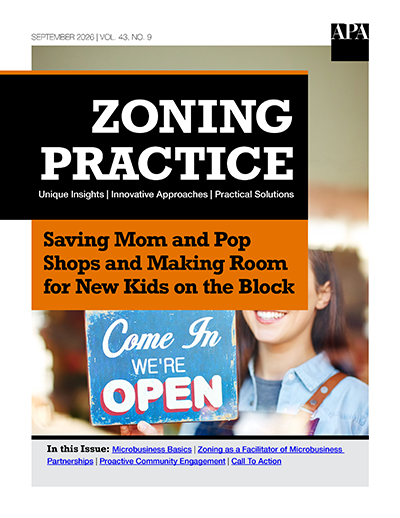
Each issue of Zoning Practice provides practical guidance for planners and land use attorneys engaged in drafting or administering local land use and development regulations. An annual subscription to ZP includes access to the complete archive of previous issues.
Top image: Felix Photographer / iStock / Getty Images Plus