


Sept. 10, 2026
Across my career, I cannot remember a time when the future of urban planning felt beyond my imagination, at least when it came to technology. I do today.
I have been researching and working with artificial intelligence for quite a while, and I am still not sure what to make of it. While that is an uncomfortable starting point, it’s an honest one, and I suspect many planners share that feeling.
So, let me start with a question: What is the planner’s North Star? What are we trying to do, what do the people we serve actually need, and does AI change any of that?
I also want to acknowledge, at the outset, that planners are bringing a wide range of feelings to this moment. Some are genuinely excited, some are tired of the hype, and many are quietly (or openly) anxious: unsure where to start, uneasy about what AI will mean for their jobs and their communities, and troubled by the environmental footprint of the systems and infrastructure that support it, among other concerns. Those reactions are not obstacles to clear thinking. They are part of the landscape, and any useful perspective on AI must consider them alongside the technology itself.

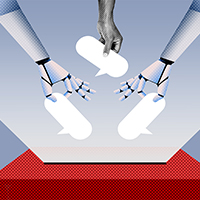
After 30 years of teaching, Tom Sanchez, PhD, AICP, now works independently with planning agencies preparing for AI. Illustration by Catherine Bixler.
I am approaching these questions by looking backward first because I have felt this uncertainty before. The difference is that every earlier tool needed someone to run it; AI arrives promising to run itself. Whether that promise holds is worth keeping in mind as you consider this essay.
My first experience with a computer came in 1974 while in eighth grade. My math teacher had a DEC-Writer II with an acoustic coupler (an early modem). The terminal had no processor, memory, or screen. Everything you typed and everything it returned was printed noisily on green-bar paper. I thought it was fun, but for years afterward, I had nowhere to plug that interest in. There were no computers in my high school classes nor any in my undergraduate coursework at the University of California, Santa Barbara.
My computer drought ended in 1984, when I started my master’s in city and regional planning at California Polytechnic State University, San Luis Obispo. Steve French, who was on the faculty, reintroduced me to the machines: library terminals, the Apple IIe, the IBM PC 5150, DOS, Fortran, VisiCalc, and a little GIS. I got my first home computer, a Commodore 64, that year too.
I was fascinated by the hardware, but more so by who was adopting it. For my thesis, I surveyed all 497 city and county planning departments in California, hearing back from 403 of them. About 60 percent reported using computers in some fashion. Of those that were not, half said they had no plans to get computers anytime soon. Certainly, they all rely on computers today, but that gap between technology arriving and a profession deciding what to do with it has stayed with me ever since.
I thought my computer skills would set me apart in the planning job market. In 1986, at one interview with a consulting firm, the person finishing the interview thought that my spreadsheet and GIS work was interesting, but said, “We don’t have any computers in our office.”
I did not get that job.
The accountants, it turned out, were well ahead of the planners, and for a couple of years I worked in computer consulting for a large accounting firm. I found my way back to planning through a real estate developer client, where I handled project coordination and permit submittals from “the other side of the counter.” That experience taught me the development process in a way quite different from my MCRP.
Professional practice is built on listening, collaborating, negotiating, and learning from people, because we plan for human communities and human needs, and no model does that for us. The harder questions are still out there.
After the real estate market took a downturn in the late 1980s, one of the few jobs I could find was working at the computer help desk at a microchip manufacturing firm in Orange County, California, where there wasn’t an ounce of planning involved.
Long story short, I decided to pursue my PhD in planning, which had been on my mind since my master’s degree days. I was accepted to Georgia Tech, where I dug into GIS, which was followed by teaching at five universities, almost always with some computing, data analysis, and GIS in my teaching load and research. Along the way, I built courses on technology and cities.
Over the course of about 50 years, I watched computing go from that DEC-Writer II terminal to a supercomputer that now fits in my palm.
Storage migrated from floppy disks to the cloud; processing moved from central machines to local ones and back again to centralized services; and everything got faster. Through all of it, one thing held steady. Each new tool — the spreadsheet, the database, GIS, and the web — helped us do work we were already doing, only faster and on a greater scale.
For the most part, however, the work itself remained recognizably the same. That is what makes this moment different.
What about planners’ jobs?
While I was finishing PAS Report 604, Planning with Artificial Intelligence, for the American Planning Association (APA) in late 2022, OpenAI released ChatGPT. I barely had time to mention it, including it in a paragraph on natural language processing, and I did not list it among the AI tools planners were using because almost none were.
That was about four years ago. By the time my follow-up book, AI for Urban Planning, came out in 2025, the ground had already shifted, and it keeps shifting. The number of National Planning Conference sessions on AI has climbed quickly, and so have mentions of AI in transportation, housing, environmental planning, and planning ethics.

Listen to this Trend Talk conversation with Tom Sanchez, PhD, AICP, and APA Research Manager Joe DeAngelis, AICP, on how AI is affecting planning education and what to expect in the years ahead.
The Association of Collegiate Schools of Planning and its European counterpart, the Association of European Schools of Planning, have made AI a growing presence in their conferences and journals. At the recent World Planning Schools Congress in Helsinki, Finland, AI sessions drew planning educators from around the world.
The difference AI delivers is not speed. These are tools: They hold the operations, but a human still does the work. The new systems carry something the old tools did not, a kind of intelligence inside the tool. A large language model can design the steps for a task, carry them out, gather the data it needs, run the analysis, and return the result as text, tables, maps, graphics, and more.
I know how that sounds. If AI can do a planner’s work, can it replace the planner? Not today, in my opinion. It can do some of what we do, and it does some of it well: drafting, summarizing, analyzing, and generating first passes that a planner can refine. But professional practice is built on listening, collaborating, negotiating, and learning from people because we plan for human communities and human needs, and no model does that for us. The harder questions are still out there.
We are told AI will save time, freeing planners for the creative, interpretive, higher-value parts of the job. Maybe, but much attention and effort need to be put into fact-checking AI output. And we have seen “freed up” time before. Word processing did not lighten the office; it dispersed the typing and erased the secretarial role. GIS ended hand-drawn maps and redirected that effort toward accuracy rather than redrawing. Saved time tends to get reabsorbed, sometimes into better work, sometimes into an expectation that fewer people can carry the same load, and sometimes into work that did not exist before — work that needs more planners, not fewer.
Planning has also moved from paper to digital files, the internet, and email, each step widening access and speeding the exchange of information. AI extends that arc dramatically.
A model trained on a vast slice of the internet can be supplemented with local context, an agency’s comprehensive plan, zoning ordinance, spatial data, and past studies, putting a kind of encyclopedic, local awareness at a planner’s fingertips that didn’t exist before. That is a genuine gain, and it is also a reason to ask harder questions about where that knowledge comes from and who stands behind it.
Where are we going as a profession, and how will we know when we arrive? Will AI mostly make planning faster, or will it make planning better, and how would we tell the difference? I do not think we answer those questions by waiting to see what the tools do to us. We answer them by deciding what we want from the tools.
Consider the cost of all this, which is where much of planners’ uneasiness lives. There are environmental concerns about the water and power these systems consume, land use questions about where data centers get built, worries about planning jobs, and serious issues of data privacy, surveillance, security, baked-in biases, and public trust.
Layered on top is a simpler and very human feeling: Where do I even start? None of this is hypothetical — these questions are already on planners’ desks, and none of them has a settled answer. There is a great deal of complexity, and many trade-offs, and I do not think any honest account of AI in planning can pretend otherwise.
Back to our North Star
Which brings me back to the North Star. I am not arguing that we should try to halt any of this, and I am not here to tell you AI is good or bad. But the questions matter more than the hype.
Is planning about predicting the future, or about making sense of a world that refuses to be predicted, and where does AI fit in either case? Where are we going as a profession, and how will we know when we arrive? Will AI mostly make planning faster, or will it make planning better, and how would we tell the difference? I do not think we answer those questions by waiting to see what the tools do to us. We answer them by deciding what we want from the tools. That means learning enough about AI to evaluate it honestly, weighing its costs against its benefits, and making intentional choices about where it should, and should not, sit in our practice.
The choice is between letting these changes happen to the profession and engaging with them deliberately, and I would urge the second. The AICP Code of Ethics and Professional Conduct provides our compass: Our objective is to serve the public interest. If that is the North Star, then every step with AI, every adoption, and every refusal can be checked against it.
I have spent about 50 years watching computers move from a curiosity to something that can do a version of my work in minutes or while I sleep. I’m still not sure where this one leads, but I am sure about the question we should keep asking at each step, which is whether it serves the people and communities we are here for.
P.S. I wrote the first draft of this essay on paper, with my favorite Kaweco fountain pen, to remember the days before keyboards. I still had to type it all in and edit along the way.
RECOMMENDED ARTICLES