
Trend Talk Podcast Series
About This Series
Trend Talk is a companion series to the APA podcast that highlights emerging trends shaping planning practice. It features expert conversations on foresight, uncertainty, and innovation in topics like climate action, technology, transportation, and governance to help planners understand and respond to change.
Current Episode

Planning Education, Uncertainty, and the rapid evolution of AI with tom Sanchez, AICP
In this episode of the Trend Talk podcast, a companion series for the 2026 Trend Report for Planners, Joe DeAngelis, AICP, research manager at APA, chats with author and professor Tom Sanchez, AICP. The two engage in a thoughtful discussion about the rapidly evolving landscape of artificial intelligence (AI) technology and planning, reflecting on the unpredictability of the future, the importance of learning from past trends, and the need for planners to remain both cautious and open-minded.
Episodes
2026
Planning Education, Uncertainty, and the Rapid Evolution of AI with Tom Sanchez, AICP
A conversation that explores the rapidly evolving landscape of artificial intelligence (AI) technology and planning, reflecting on the unpredictability of the future, the importance of learning from past trends, and the need for planners to remain both cautious and open-minded.
Governance, Preemption, and the Importance of Protecting Local Representation with Nestor Davidson
A conversation that explores state and local governance tensions, focusing on preemption, shared authority, and local representation. It highlights impacts on planning practice, environmental and social trends, and the challenges shaping cities and policy decisions.
Planning Education, Uncertainty, and the Rapid Evolution of AI with Tom Sanchez, AICP
A conversation that explores artificial intelligence and planning, reflecting on uncertainty, past trends, and future impacts. It emphasizes cautious openness, adaptability, collaboration, and leveraging technology to support innovation in planning practice and decision-making.
The Current — and Future — State of Hazard Mitigation Planning with Chrissy Caggiano, AICP
A conversation that explores hazard mitigation and climate adaptation in planning, focusing on evolving professional roles, education, and practice. It examines uncertainty, shifting responsibilities from federal to local governments, and integrating resilience into planning systems.
The Circular Economy, Climate Action, and Urban Sustainability with Helen Santiago-Fink
A conversation that explores circular economy, climate action, and technological innovation in cities, highlighting how artificial intelligence and digital tools can support sustainability. It emphasizes community engagement, local circularity, and forward-thinking strategies for urban resilience.
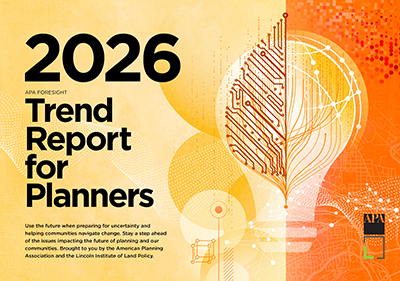
2026 Trend Report for Planners
APA FORESIGHT
The 2026 Trend Report for Planners, developed by the American Planning Association and Lincoln Institute of Land Policy, highlights over 100 current, emerging, and future trends identified by the APA Foresight team, offering neutral insights on their relevance to planning practice.
2025
The Role of Planners in Space Exploration with Justin Hollander, FAICP
A conversation that explores human settlements beyond Earth, examining challenges and ethics of planning cities on the Moon and Mars. It highlights lessons from space exploration for urban development and opportunities in the emerging space industry planning.
The Future of Transportation with Beneetta Mary Jose
A conversation exploring transportation trends in micromobility, electrification, and planning approaches, balancing proactive and reactive strategies, highlighting how emerging professionals influence the field, the role of children's perspectives, and visions for sustainable human-centered network planning.
The Future of Public Sector Planning with APA President Sue Schwartz, FAICP
A conversation about evolving public sector planning, hiring challenges, political polarization affecting community engagement, and planner resiliency, alongside managing technological change, hybrid work balance, and preparing for future equitable and resilient communities planning field trends.
2025 Trend Report for Planners

APA FORESIGHT
The 2025 Trend Report for Planners, developed by the American Planning Association and Lincoln Institute of Land Policy, identifies over 100 current, emerging, and future trends organized by urgency and themed clusters, offering neutral, fact-based insights for planning practice.